

On March 7, 2026, Kaelan Deese, justice reporter for the Washington Examiner, published a story about a hole in the Epstein files.
The Justice Department, Deese reported, had begun restoring records that reporters had discovered were withheld by the DOJ in their staggered Epstein files release. The records — a batch of typed FBI interview summaries (known as “302” forms) related to a South Carolina woman who accused Jeff Epstein and Donald Trump of raping her when she was a child — had been, in the department’s telling, "mistakenly coded as 'duplicative.'" After weeks of pressure from the public, the press, and members of Congress, the DOJ finally relented, releasing the missing 302s the evening of March 5.
Note: Kaelan Deese and the Washington Examiner were asked for comment; this piece will be updated with any on-the-record reply. The allegations against Donald Trump described in the FBI materials are uncorroborated; he has denied them and has not been charged.
Deese’s report, published two days after the release, was titled, “What’s still missing from Epstein files? DOJ begins restoring removed documents.” He cited an anonymous “senior DOJ official” source who acknowledged to Deese that, while "some mistakes were made," the department got it "99% right."
However, the DOJ was still refusing to release 37 additional pages of contemporaneous handwritten notes that agents took during those interviews, which had informed the 302s. (The survivor is also known as “Jane Doe 4,” her pseudonym in a civil suit she brought against the Epstein estate in 2021 and reportedly settled for a monetary payout.) Department officials have claimed those notes are “duplicative” of the 302 writeups and therefore don’t need to be released.
Deese, however, had quietly released them already. The day before he published his article about “what’s still missing,” he uploaded them to his public Scribd account – entirely unredacted. This meant that, for the last five months, anyone with internet access could view the notes, which had Jane Doe 4’s real name all over them, as well as significant biographical details and the names of childhood friends and family members who she said could corroborate elements of her story – all of which she gave the FBI in confidence, and all of which the DOJ had redacted in the 302s. The Bureau had also granted her a status rare even among Epstein survivors – “PROTECT SOURCE” – indicating her identity was an especially sensitive secret.
But Deese, who regularly publishes articles with a favorable conservative gloss, was part of a small, select group of people that DOJ brass secretly decided were – unlike the public and members of Congress – able to be trusted with these allegedly “duplicative,” ultra-sensitive files. Entirely unredacted.
And Deese, given that special trust, immediately uploaded the files to his public Scribd account, “reportoftheday,” describing them as “classified” DOJ documents. On its own, this may have been an “inadvertent” mistake, as Deese’s editor claimed in an email this week when we flagged the unredacted documents to her. (Deese took the files down shortly after we contacted his editor.) But Deese didn’t merely post the notes to his online library. The justice reporter, who has 7 years of journalistic experience, also happily shared a missing file with at least one random person who had discovered the posts.
We found that person, who shared his text message exchanges with Deese.
This week, after independent journalist Ellie Leonard published a story about the notes, this person tied the “reportoftheday” Scribd account to Deese. And the person had a question for him: Only two note-sets had been published; what happened to the third? The person tracked down Deese’s number and texted him. Here’s how that conversation went, according to the texts that were shared with us.
“Hi, would you happen to know who/what company runs reportoftheday on scribd?” the person wrote. “I see several articles you’ve written that mention them, and I would love to message [the account owner].”
“That’s me!” Deese replied. “I just use it for uploads when I need them.”
When the stranger asked Deese how he “came across the Jane Doe 4 interview notes,” Deese immediately revealed his source: The Justice Department.
“It’s been a little while, but [if I recall correctly] most of this stuff was sent to me by a source within DOJ,” Deese wrote.
The stranger also asked Deese about the missing file. He replied, “I remember the scribd file upload having some problems uploading properly,” adding, “I eventually gave up on trying to get it on.”
But Deese didn’t give up on the stranger. Instead, he dug up the third file.
“Hey,” Deese wrote, shifting the conversation from text to Signal, an encrypted messaging app. “I found the missing file from scribd.” Before the stranger replied, Deese sent him a PDF of the file, writing, “It should be this one, right?”
“No shit,” the stranger replied. “Thank you SO much.”
The stranger told Deese he’d like to share the documents with others, “Provided that I censor necessary Information, as there is some identifying info in here.” He asked if Deese wanted credit.
“No credit needed,” Deese replied. “This is public now I believe.”
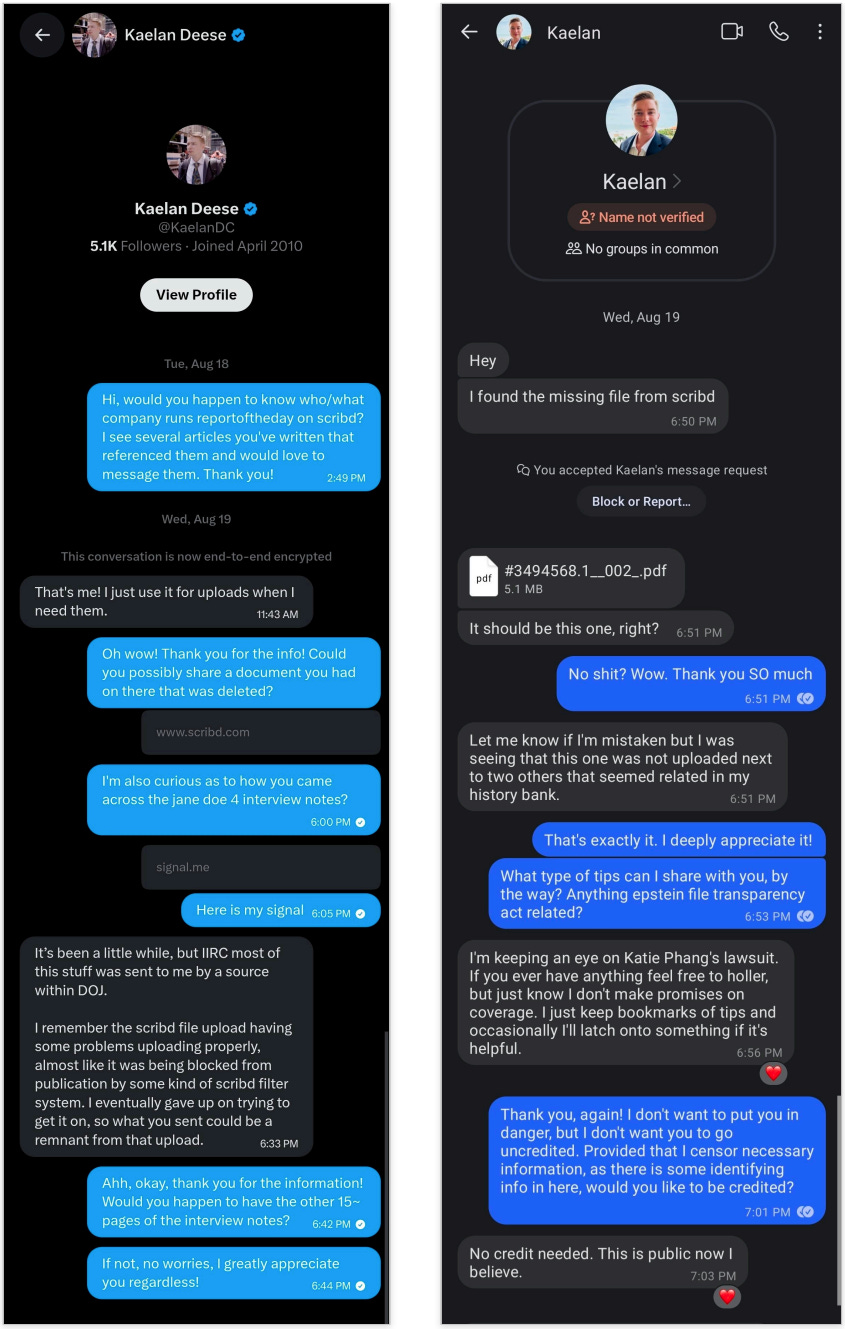
Deese, who has reported extensively on the Epstein files and the DOJ’s release, was wrong. They weren’t public. And if the reported had indeed been “keeping an eye on [journalist] Katie Phang’s lawsuit” against the DOJ, as he claimed in one message, he should have known that – the handwritten notes are prominent among the scads of documents Phang is trying to pry from secrecy.
Katie Phang was contacted for comment on this story, and responded:
“The timing of the discovery and release of these unredacted handwritten notes is interesting, considering they became public after the status hearing before Judge Sullivan in my case against Todd Blanche. There also remains an open question as to the authenticity of these published notes. That question could be readily answered if the FBI would just comply with the Epstein Files Transparency Act and release the notes they’ve been legally required to do. Regardless, what these notes DO show is that they are not “duplicative” of the FBI 302s as Blanche has asserted and they clearly contain allegations of sexual abuse and physical abuse committed by Donald Trump with a victim who was 13-15 years old at the time. So the Trump DOJ has no incentive to release them.”
It’s unclear why no Examiner article ever pointed to these notes. We went through the whole Scribd account. Every upload is a source document sitting beneath a story that Deese wrote. The only exceptions are the Jane Doe 4 interview notes – among the most sought-after files remaining in the DOJ’s custody. These documents match no published Examiner article. He never wrote about them.
Others, however, did. That’s because Deese wasn’t alone: The notes that the public was told were too "duplicative" to release were not too duplicative for certain reporters.
In mid-February, independent journalist Roger Sollenberger broke the news that the FBI had interviewed the woman four times, while DOJ had released only one interview to the public and pulled down a file that pointed to the missing three interviews. Nina Burleigh and Katie Chenoweth had come at the same hole independently, in American Freakshow, reading the FBI's own case indices. Mainstream outlets including NPR, CNN, and The New York Times confirmed the story, noting a total 53 missing pages.
Two outlets, however, somehow got their hands on those three missing 302s: The rightwing propaganda factory Breitbart; and The Guardian, which ran a piece about the missing records written by freelancer Jacqueline Sweet, who wrote dismissively about Jane Doe 4’s claims.
And it was Sweet who published a March 24 “exclusive” in The New York Post about the unredacted, withheld handwritten notes. Sweet framed the story as she had in The Guardian: casting doubt, saying there was "no evidence" the woman ever met Epstein or Trump, and citing a childhood friend who denied attending a concert in the 1980s as described by Jane Doe 4. She also carried the DOJ’s talking point that the notes were duplicative, “largely matching 302 forms already made public by the Justice Department,” and said the only new information in them were “two additional details about the accuser’s life — a brief school trip to Washington, DC, and a road trip she took with a friend to New Jersey.”
The next week, Sweet’s exclusive was matched by South Carolina outlet the Post and Courier. That paper had already covered Jane Doe 4’s allegations extensively, including a detailed fact-check that corroborated many details she provided the FBI. Contrary to the claims of DOJ and Sweet, the Post and Courier reported that the notes contained important new information that wasn’t public – most specifically the fact that Jane Doe 4 had provided names of witnesses who could corroborate key elements of her story.
It’s unclear whether Sweet and the Post and Courier, with diametrically opposed reports, got their access to the notes from the same source. The Post and Courier’s report – titled “FBI Records Detail Potential Witnesses of SC Epstein Victim. They Aren’t Public” – was published April 3, the day after Trump fired then-Attorney General Pam Bondi.
Deese, with the same documents and the same beat, did neither. He wrote about the DOJ’s hole in the Epstein files, but he never wrote about how he had filled it.
Amidst all the confusion - obvious deliberately created confusion - it is clear some right wing journalists were actively seeking to undermine witness testimony against trump.
They need to be accused of this otherwise their face, in public.
I read through Ellie Leonard's release the other night and it followed and filled in a lot from the redacted releases from over the summer. It's the incrementalist release of further parts of the un-redacted files the process has left as becoming redundant and creating confusion. I kept going and reminding myself that I've seen this before or this fills in that and back and forth. It's leading me to believe that there is no end and ultimately no justice.
Thanks for all you are doing to help sort it out.