

In 2004, Ghislaine Maxwell and Jeffrey Epstein each put $4,000 into Gary King’s race for Congress, filing from the same St. Thomas address. In 2006 King said he had never met the man (Santa Fe New Mexican, Aug. 16, 2006). In August 2010, the day after New Mexico decided Epstein need not register as a sex offender, an assistant in King’s own office confirmed a Saturday meeting at a Santa Fe restaurant.
On August 20, 2010, that assistant emailed Epstein’s scheduler from a state government address, ewood@nmag.gov. Subject line: MEETNG WITH AG GARY KING IN SANTA FE.
“Here are the arrangement we spoke about on the telephone just awhile ago,” she wrote. “AG King can meet with Mr. Ebstein at 3:30 p.m. on August 28th.” The restaurant was “Jinja Bar and Bistro located in the De Vargas Shopping Center @ 510 No. Guadalupe Street.” She attached driving directions. At 3:08 that afternoon she sent a postscript: “P.S. AG King’s cell number is,” followed by a number now redacted. The message is signed “Lisa Wood”; the header gives her name as “Wood, Elisa”.
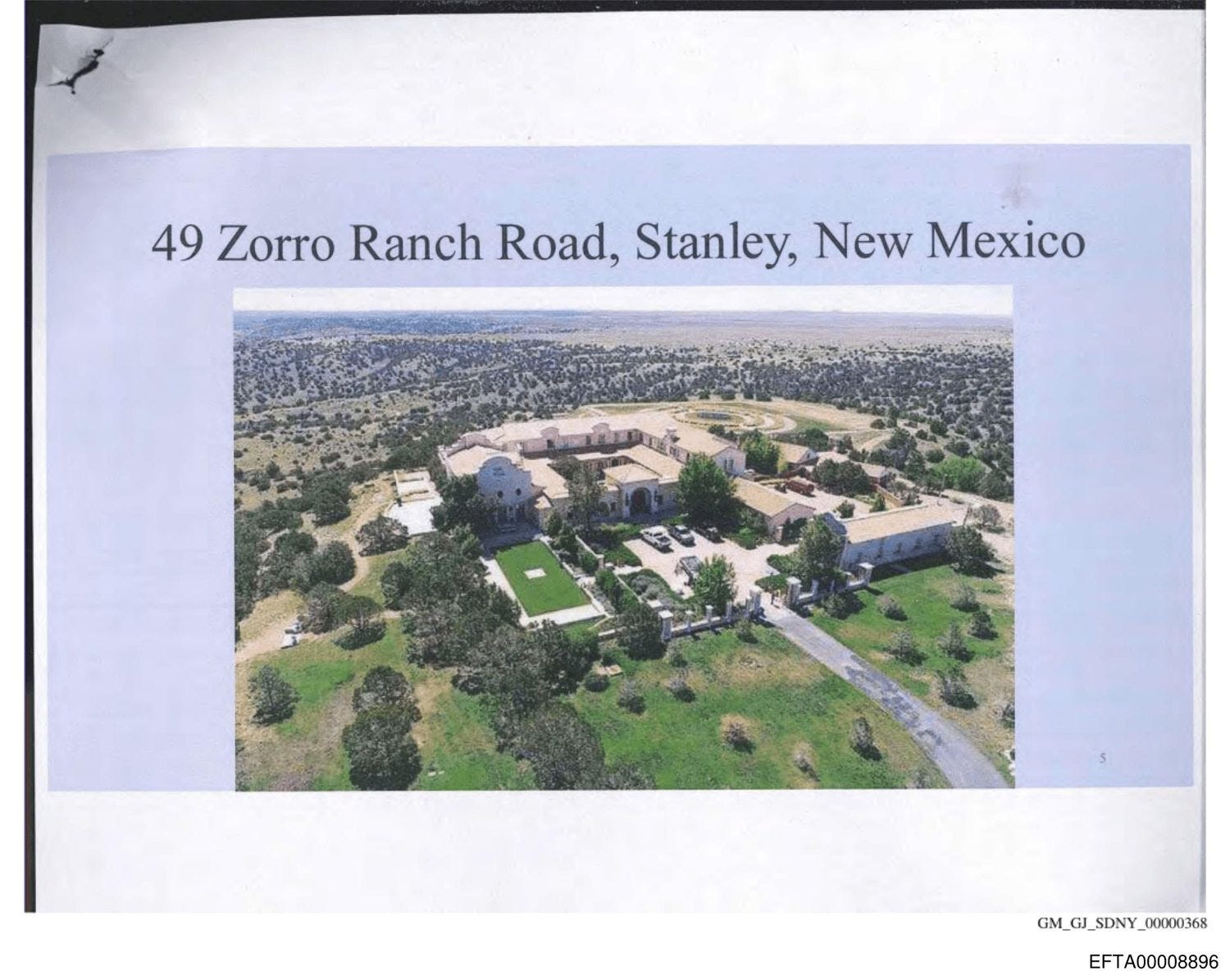
The day before, the New Mexico Department of Public Safety had written to Epstein at 49 Zorro Ranch Road and told him he was not required to register as a sex offender in New Mexico.
Two weeks before that, Epstein’s lawyer had told the same office that his client “has not visited NM since his conviction in Florida”.
Fourteen days after that letter, Epstein’s Gulfstream landed in Albuquerque. Three of the six names on the manifest are blacked out.
This is not the story that ran in February. That story was the plane: King, then attorney general and the Democratic nominee for governor, flew to Washington in September 2014 on a charter booked through an Epstein company, after Epstein-linked companies wrote his campaign checks from a shared address in St. Thomas (NM Political Report, Feb. 17, 2026). King said he thought the jet came from NetJets, and that Bill Richardson had helped arrange it (Albuquerque Journal, Feb. 17, 2026; KOB, Feb. 19, 2026). The emails say he asked to use Epstein’s plane. They also say the contact address that went out with the booking was the attorney general’s state office, not the campaign’s.
The plane is real, and it is the part everyone already has. What sat unused in the same release is the rest of the file: the 2004 federal filings that name Maxwell as a donor; the state’s sex offender correspondence and the August 2010 manifests; the Deutsche Bank pages that later used King’s name to identify four of Epstein’s companies; and a land office file addressed, over and over, to the attorney general’s cousin.
No document reviewed for this piece shows that King knew of any crime at Zorro Ranch, that any victim complaint reached his office, or that his office touched the registry decision. Those three absences are where the paper stops. It does not stop early.
The first checks
In 2004 King ran for Congress in New Mexico’s second district and lost to the incumbent, Steve Pearce. His committee, King for Congress, filed from a post office box in Carlsbad. Four people connected to Epstein’s office appear in that year’s reports.
On June 22, “Epstein, Jeffry, Mr.,” of 6100 Red Hook Quarters, Suite B-3, St. Thomas, occupation “Retired,” gave $2,000 designated to the primary and $2,000 to the general (filing 127614, transactions C2613 and C2614).
On August 24, Darren Indyke, Epstein’s lawyer, did the same from Livingston, New Jersey (filing 140986, C4087 and C4088).
On August 31, Eric Gany of Wilton, Connecticut, employer NY Strategy Group, LLC, gave $2,000 (filing 140986, C4959).
On September 1, Ghislaine Maxwell, at the same St. Thomas address as Epstein, occupation “Retired,” gave $2,000 to the primary and $2,000 to the general (filing 140986, C4962 and C4963).
The seven lines total $14,000. The Maxwell and Epstein pairs are two receipts each, not one gift reported twice: the campaign’s own electronic filing gives each line its own transaction identifier, its own election designation, and a running aggregate of $4,000. The Federal Election Commission’s itemized receipts viewer for the same report shows the Maxwell pair as two rows. That viewer suppresses contributor names, which is why the name is cited to the filing itself.

6100 Red Hook Quarter B-3 is the address the Santa Fe New Mexican would identify ten years later as the shared address of the companies giving to King’s campaign for governor (Sept. 9, 2014). The campaign had already recorded it for Epstein and for Maxwell in 2004.
Gany is the name that looks obscure until you open the bank file. A 2003 JPMorgan Chase client record for Maxwell lists her primary address as care of New York Strategy Group, “Attn: Eric Gany,” at 457 Madison Avenue, the same Madison Avenue address Zorro Trust used on New Mexico land office correspondence (EFTA01305252, p. 307). The bank’s summary of findings is one sentence long:
She is now in the process of opening up a new checking account, which Eric Gany will have POA. Eric works for Jeffrey Epstein.
The same file carries a Dun & Bradstreet record for “ERIC T GANY” at 66 Little Brook Rd, Wilton, Connecticut, the address on the FEC line.
So the four 2004 donors are Epstein, his lawyer, Maxwell, and the man a 2003 bank file describes as working for Epstein and holding power of attorney over her account.
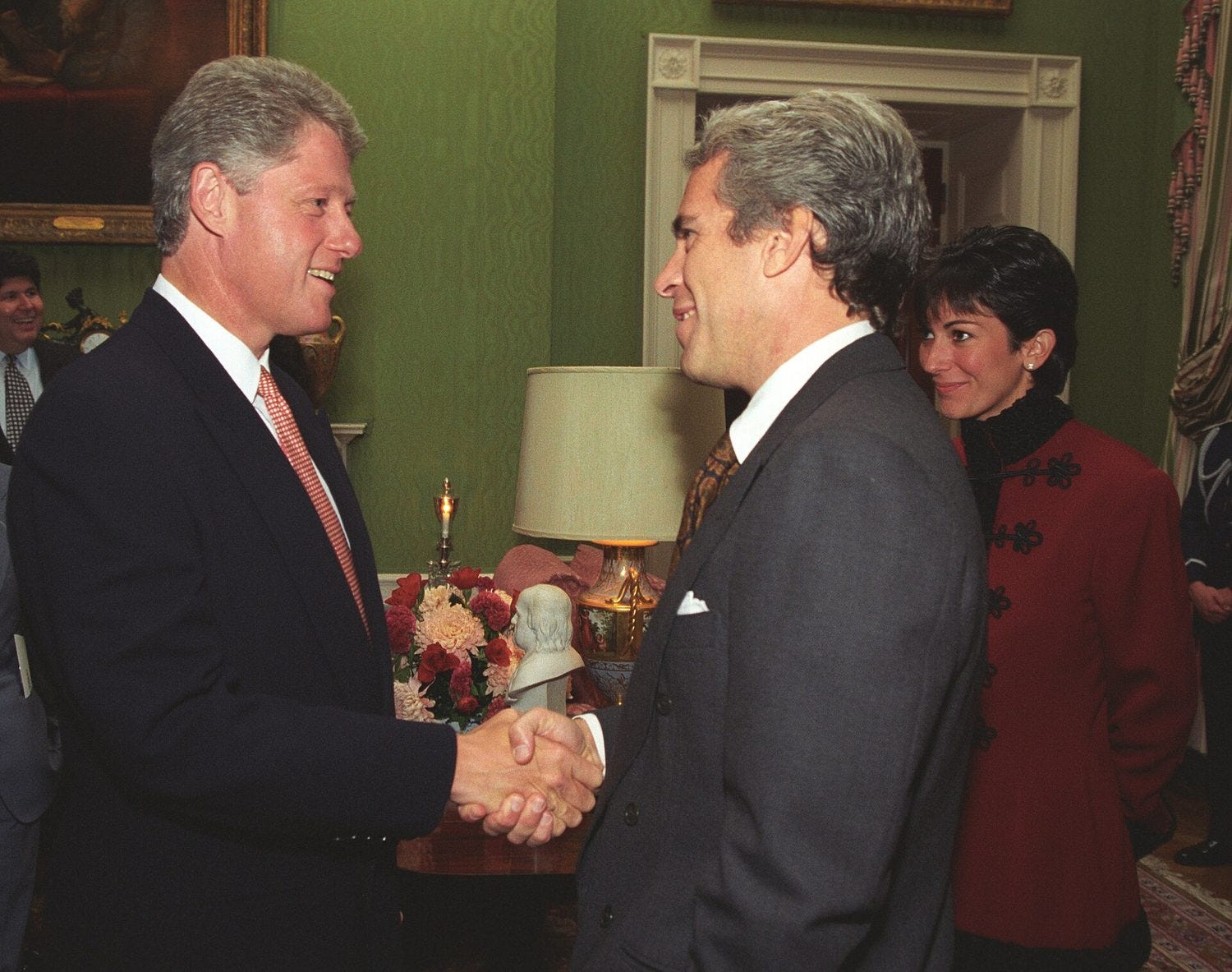

None of this was sealed. It sits in the committee’s own quarterly reports with the Federal Election Commission. LittleSis has logged “Ghislaine Maxwell gave money to Gary King,” $4,000, dated September 1, 2004 (entity 44872). King’s Wikipedia page notes Epstein’s 2004 money and stops there.
Twelve articles were fetched and searched for this piece: NM Political Report (Feb. 17 and Feb. 23), the Albuquerque Journal, ICT, KOB (Feb. 19 and Feb. 28), Reuters, the New Mexican’s King family piece, its Sept. 9 and Sept. 10, 2014 stories, the Daily Beast in 2019 and the AP in 2014. We were not able to find Maxwell named as a King donor in any of them. The Daily Beast names her, as Epstein’s associate and as the defendant in the Giuffre litigation, not as a donor to anyone. We were not able to find Gany mentioned at all.
Two years later King was running for attorney general. The state’s contribution database records two more gifts from Jeffrey Epstein personally: $10,000 on December 5, 2005, and $5,000 on June 19, 2006 (dataset 392). After Epstein’s Florida arrest became public, the New Mexican listed the New Mexico politicians holding his money. King said his was going back.
King said Tuesday that “to avoid any appearance of impropriety,” he plans to return the $15,000 to Epstein.
“I don’t think I’ve ever met him personally,” King said. “He knows other members of my family better.”
That is August 16, 2006 (EFTA01661603, p. 30). Two years before he said it, a donor listing Epstein’s St. Thomas address and the occupation “Retired” had written his congressional campaign two checks. Whether King knew that is not in the record. The filings are.
One correction has been sitting in the clips for a decade. In 2014 the same newspaper wrote that King’s 2006 money had come from “an Epstein company called The Zorro Trust”. The 2006 article says the opposite: the Zorro Trust money was Bill Richardson’s, and King’s $15,000 is listed separately (EFTA01661603, p. 29-30). The state database records King’s 2005 and 2006 contributions under Epstein’s own name.
The week the registry question was decided
On July 23, 2010, the Department of Public Safety wrote to “Jeffery E. Epstein, 49 Zorro Ranch Rd., Stanley, NM.” Florida had notified New Mexico that he was a convicted sex offender “and that you meet the requirement to register in New Mexico.” Failure, the letter said, “will result in a 4th degree Felony.” It was copied to the Santa Fe County Sheriff and signed by Regina Chacon, assistant bureau chief of the Law Enforcement Records Bureau.
Peter Schoenburg, Epstein’s New Mexico lawyer, answered on July 27 that his client would register under the federal statute “upon his next visit to the New Mexico vacation home,” and that “at your suggestion, I intend to have Mr. Epstein call the Santa Fe Sheriffs whenever he is in New Mexico”.
On July 30 he wrote again, recording what Chacon had told him by telephone. The July 23 letter, he wrote, “is a form letter sent out to every offender,” and “does not reflect a determination by your office that Mr. Epstein actually qualifies under NM law as an offender who is required to report.” Her assistant would review the file. Then this:
As you know, Mr Epstein has only recently been released from service of his sentence and has not visited NM since his conviction in Florida.
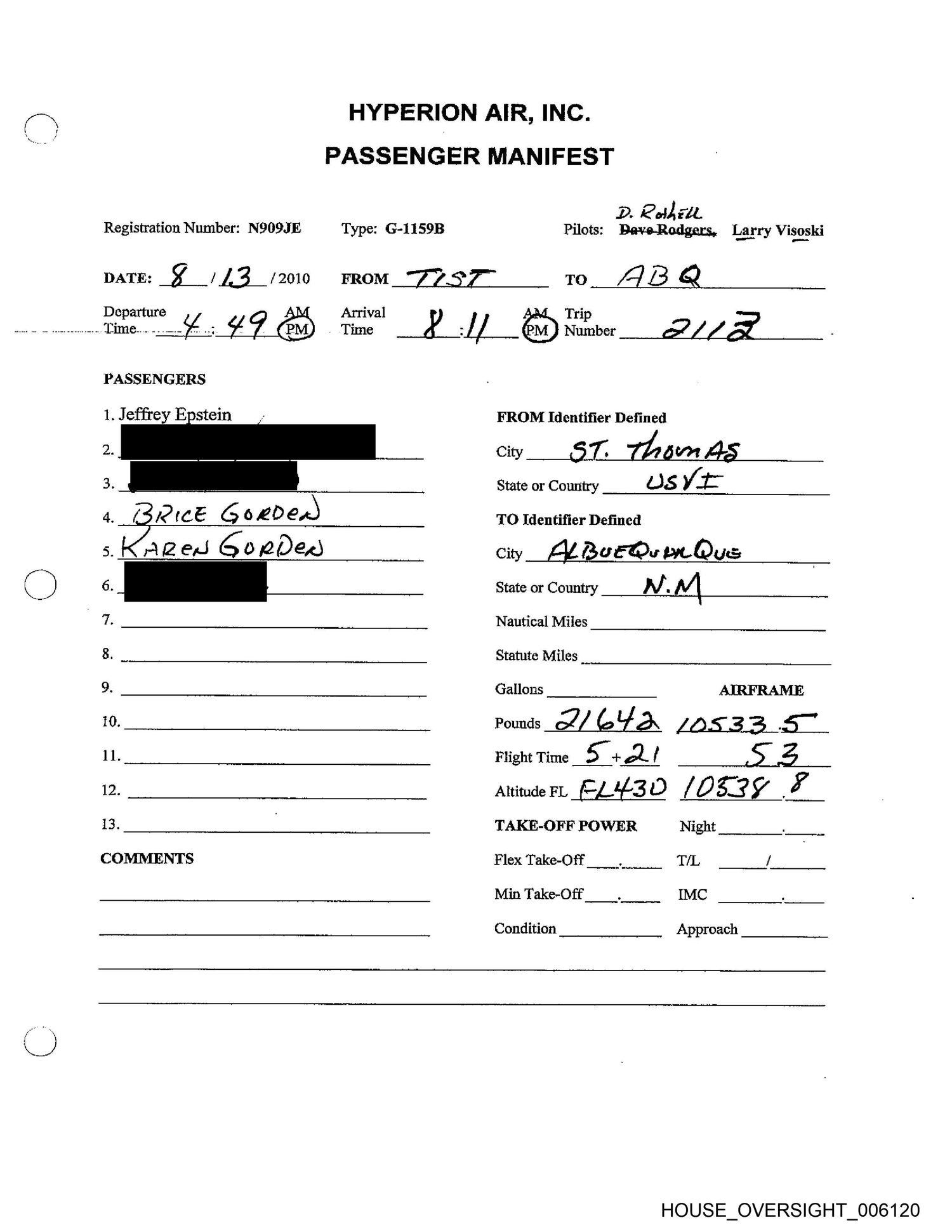
On August 13, at 4:49 p.m., N909JE lifted off from St. Thomas. It landed in Albuquerque at 8:11 p.m. The Hyperion Air passenger manifest lists six names. Jeffrey Epstein. Brice Gorden. Karen Gorden. Three redacted.
The state’s review was still open. Chacon did not write again for six days.
At 2:11 a.m. on August 17, Epstein moved his own schedule up a day: “go to gunnision wed. arrive new york wed night.” A staff member confirmed that morning, “Wheelsup still 9am tomorrow morning to Gunnison?”. The aircraft left Albuquerque for Gunnison, Colorado on the 18th and continued to Teterboro the same day, carrying Epstein, a passenger listed only as “Nick,” and three redacted names.
On August 19, the day after he left the state, Chacon wrote again.
After reviewing your file it is our determination that under the current NMSA 29-11A you are not required to register with the State of New Mexico at this time for your 2008 Florida conviction of Procuring Person Under 18 for Prostitution. However, while you reside temporarily in New Mexico you may be required to register per Title I of the Adam Walsh Child Protection and Safety Act of 2006.
That is the letter Epstein’s lawyers produced for the next nine years, and the one his defense filed with the federal court in 2019 (EFTA00039383, p. 20).

The next day, Lisa Wood sent the Jinja confirmation. Lesley Groff forwarded it on the 24th, noting she had already sent it the week before “to [redacted] and Brice last week.” Epstein forwarded the whole chain to himself on the morning of the meeting.
King’s public account of that meeting is tea and condolences. His father, Gov. Bruce King, had died the previous November. He told Reuters they drank tea, that Epstein expressed condolences, and that they briefly discussed Epstein’s dealings with the Santa Fe Institute (Reuters, Mar. 21, 2026). Nothing in the file contradicts that conversation. Nothing in the file explains who “the arrangement we spoke about on the telephone” was arranged with.
Epstein came back. On August 25 the same aircraft flew Teterboro to Phoenix to Albuquerque, carrying Epstein, a passenger listed as Igor Zinoviev, and two redacted names.
On August 26, two days before the meeting, someone in Epstein’s office relayed a call. The sender’s name is redacted.
Gary Kings assistant called and said Mr King can meet with you this Saturday in Santa Fe at 4:30pm(not 3:30pm as was originally scheduled) I have given Renee the address to where you are going and she will arrange for you to be driven.
Epstein answered “ok.”
The next day Orbitz issued a confirmation, forwarded from Epstein’s account, for a commercial itinerary from LaGuardia through Dallas to Santa Fe, arriving 3:35 p.m. on the 28th. The passenger name is redacted. Epstein was already in New Mexico. That arrival falls five minutes after the original meeting time and fifty five minutes before the time it was moved to. Nothing in the record identifies the traveler or connects the ticket to the meeting.
On August 30 the aircraft left Albuquerque for Teterboro at 5:49 p.m. Six people aboard, four names redacted. Four had flown in on the 25th. Two people joined the plane in New Mexico. Who they were is behind the bars.
Epstein’s own lawyers later said that, notwithstanding the state’s determination, he registered with the Santa Fe County Sheriff to comply with federal law (EFTA00727403, p. 7, October 2010; EFTA01147516, Indyke to a sheriff’s detective, May 2012). The registration form itself, its date, and what he declared are not in the Justice Department release. They would come from the county.
Nothing in the release puts the attorney general’s office on the Department of Public Safety’s correspondence. In July 2019, denying Epstein bail, Judge Richard Berman wrote that the court had asked the defense for whatever application materials Epstein might have submitted to the department, “believing that the Department would not initiate the waiver of Mr. Epstein’s sex offense registration on its own.” Nothing arrived (EFTA00039383, p. 20).
That gap is still open. It is the one record that could move this section toward “protected.” Until it does, the documents establish an order of events, not a cause.
The order is enough. On July 30 the lawyer said his client had not been back. On August 13 he landed. On August 19 the state wrote that he need not register. On August 20 the attorney general’s office booked Saturday. On August 25 he flew in again. On August 26 King’s assistant moved the time. On August 28 they met. King was on the ballot that November, and won a second term.
“two diffent entities 10 4”
The 2014 campaign is the part that has been in the paper since February. The comparison the coverage did not run is in the same emails.
On June 5, two days after King won the Democratic primary, his campaign emailed Epstein a letter over King’s signature: “Thank you for the opportunity to speak with you today,” and thanks for “your personal commitment to raise $50,000.00.” No corporations paragraph.
By June 13 the letter had been re-addressed care of Darren Indyke and had grown a paragraph: under New Mexico law, “Each separate corporation is considered to be a separate giver and can give up to the maximum allowed, as long as the entity was not formed solely for the purpose of giving”.
On June 17 at 12:06 p.m., Indyke flagged that King’s platform page was headed “CRIMES AGAINST CHILDREN” and asked whether Epstein risked “additional news coverage regarding his accepting of your contributions.” At 12:24 Epstein answered: “good catch, lets use co s or trusts”. At 7:34 that evening the campaign sent the letter a third time, subject line “Information on PAC contributions”. By the next morning it was with Indyke and Epstein’s accountant, Richard Kahn.
Nine contributions followed, from JEGE, Maple, Neptune, FT Real Estate, Laurel, Nautilus, Indyke personally, and Kahn’s firm HBRK Associates. None from Epstein personally (Fourth Primary report; First General report).
On August 21, Epstein’s assistant told him King had called, wanting to use “your plane” to get from Santa Fe to Washington the evening of September 8, and offering to “pay for the fuel and landing/airport fees”. Epstein to his pilot: “gary king needs a cheap charter from sfe , to wash dc”. Four days later, to his accountant:
lets orgainze the jet for gary king he can pay 11.6 we can arrange to pay through two diffent entities 10 4 please call his gyy chris khoury
Three days earlier the broker had told Epstein’s pilot, “we can do it for about $22K with all taxes and fees included” (EFTA00364053, p. 4). Sixteen minutes after Epstein’s message, the broker sent the written quote: a Hawker 800XP, Santa Fe to Dulles, September 8, prepared for Larry Visoski and Jege LLC. Total $22,060.90. Epstein’s assistant circulated King’s contact details for the booking: “Attorney General Gary King, 408 Galisteo Street, Villagra Building, Santa Fe,” which is the Office of the Attorney General, not the campaign’s post office box. Kahn replied, “i will take care of gary king office and $”.

Two days later, JEGE, LLC wrote check no. 1037 for $5,200 to “Gary King for Governor,” signed by Darren Indyke.
The campaign’s own First General report records two contributions dated September 1: JEGE, LLC, $5,200, and Maple, Inc., $5,200, both at 6100 Red Hook Quarter, St. Thomas. That is $10,400. Its Second General report records one payment to the charter operator: $22,060.90 to Injet on September 5 (Second General report). The flight was September 8, with King, Deb Haaland, finance director Chris Khoury and two staffers on the trip sheet.
Epstein’s two numbers, 11.6 and 10.4, sum to 22.0. The fare was $22,060.90. The two September 1 contributions total exactly $10,400.
What cannot be said, because no campaign email says it, is that anyone on King’s side treated those two checks as fare. The documents show a split on paper. They do not show a handshake.
The New Mexican story ran September 9. Reuters later wrote that the campaign returned $35,600 “three days after they were reported”. The campaign’s own Second General report lists seven refunds dated September 12, totaling $35,600. Laurel’s refund check, signed by King, was deposited October 27 (EFTA01271585, pp. 189-190). Indyke’s $5,200 and HBRK’s $5,200 do not appear as refunds in the filings through October 30 (Third General report).
The 2006 money is a separate tangle. King said in 2006 he would return it (EFTA01661603, p. 30), told KOB in 2026 that he had (KOB, Feb. 28), and told Reuters in 2026 that he had not (Reuters, Mar. 21). The contribution database records gifts, not refunds. His committee’s September to November 2006 reports would settle it.
What a bank and a prosecutor wrote down
In June 2017, Deutsche Bank’s private wealth research unit ran JEGE, LLC through its screens. The watchlist results came back “Auto-Closed No-Hit.” Under negative media, one result: Steve Terrell’s September 9, 2014 New Mexican story, “King donors’ address linked to sex offender,” reproduced in full inside the bank’s file. The bank ran Neptune, LLC the same way and logged it “Not Alerted,” with the same story attached.
A later know your customer file recorded Neptune’s identifying fact this way: “Neptune LLC owned by Jeffrey Epstein donated to Gary King’s campaign for $5,200 in 2006. Mr. Epstein is already noted as a PEP”. The year is the bank’s error. Neptune’s $5,200 check to King is dated June 17, 2014.
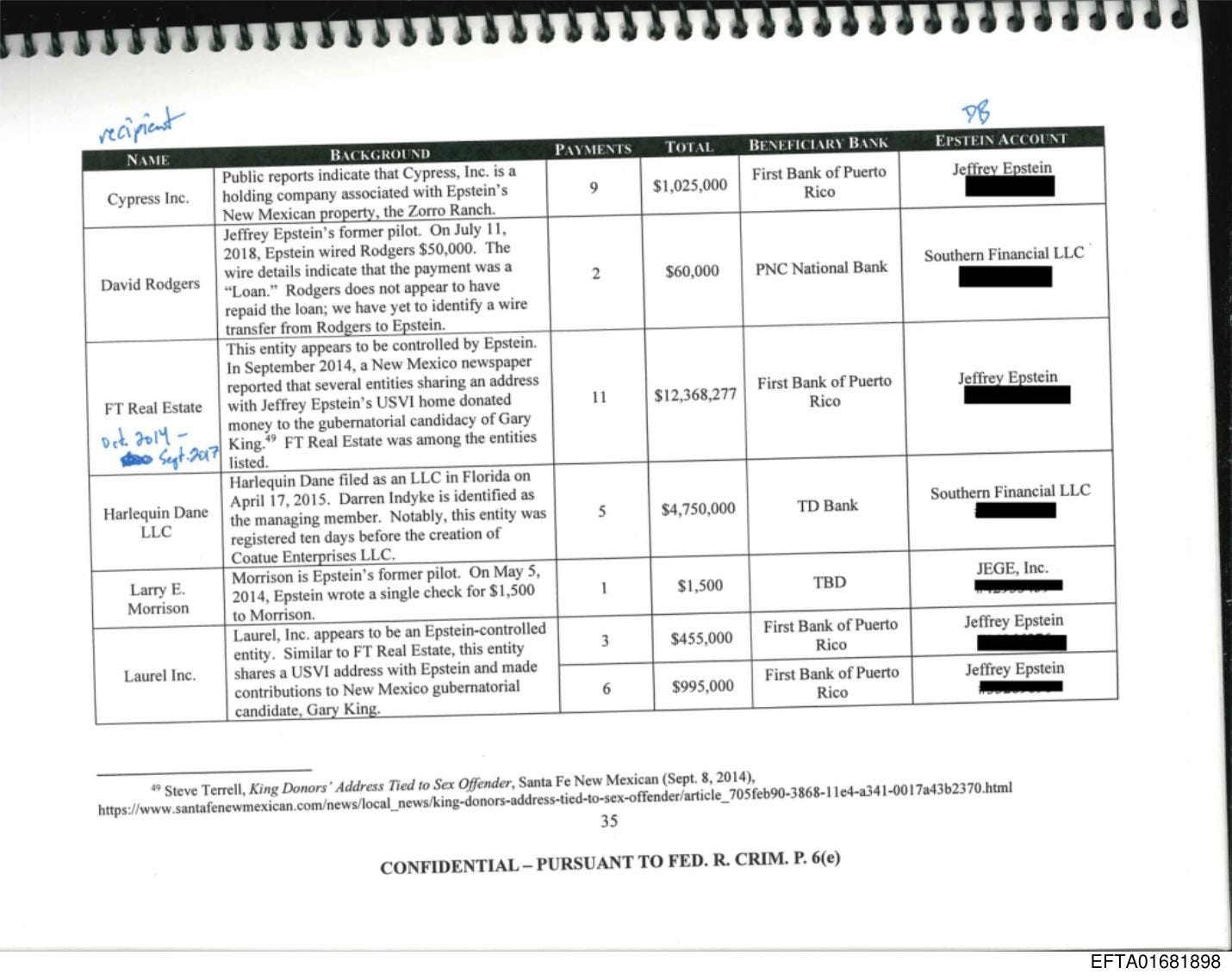
On September 12, 2019, the bank presented to the United States Attorney’s Office for the Southern District of New York. Exhibit O lists payments to Epstein-affiliated people and companies the bank had not taken on as clients, and explains why it believed each was his. Four are explained the same way.
This entity appears to be controlled by Epstein. In September 2014, a New Mexico newspaper reported that several entities sharing an address with Jeffrey Epstein’s USVI home donated money to the gubernatorial candidacy of Gary King. FT Real Estate was among the entities listed.
Laurel, Maple and Nautilus carry the same sentence, each “similar to FT Real Estate,” each sharing a Virgin Islands address, each having “made contributions to New Mexico gubernatorial candidate, Gary King.” Seven payment rows on those two pages, money out of Deutsche Bank into First Bank of Puerto Rico from an account in Epstein’s name, total $16,543,277 (three of the four companies are listed on two rows each) (EFTA01681865, pp. 34-35). The footnote for the King reference is Terrell’s story, the same one the bank’s researchers had pulled in 2017.
Five months later, prosecutors screened the Epstein material for attorney-client privilege, running a list of lawyer names and firm names against 1,189,846 documents. The report is titled “Privilege Terms_02.14.2020.” The term “Gary w/2 King,” meaning those two words within two words of each other, returned 151 documents, 302 counting the rest of each document family, and 147 unique hits. The firm name term “Gary King Law” returned zero, zero and zero (EFTA00099346, p. 5).
On the same list sit the New Mexico lawyers who did Epstein’s state work: Rothstein Donatelli, which is Schoenburg’s firm, Sutin Thayer & Brown, and the Santa Fe firm Katz Herdman MacGillivray & Fullerton.
A privilege term is a screening instruction, not an accusation, and a name can be added for many reasons. What the document shows is that in February 2020 the government was screening “Gary King” in the same pass as Epstein’s New Mexico counsel.
None of this is King’s email. It is what a bank and a prosecutor’s office wrote down about him between 2017 and 2020. Searching the twelve articles above, we were not able to find any mention of Deutsche Bank’s files, the September 2019 presentation, or the privilege term.
The cousin on the routing line
The Zorro lease file in 2004 runs through Jerry King, assistant commissioner of public lands, Bruce King’s nephew and therefore Gary King’s cousin (Santa Fe New Mexican, 2026).
On March 2 a field officer sent him a memorandum on state agricultural lease GR-2122, subject: possible theft of archaeological resources on or near state trust land inside the ranch. Inspectors found no theft. They found a graded pad and a short run of track being prepared for a caboose, “for whatever reason the lessee might have,” possibly on state land, without permission. What was “disconcerting,” the memo said, “is that a ranch escort is needed for personnel from this office to access cultural sites” (EFTA01305252, pp. 322-323).
Epstein applied for permission after the work. On April 22 a follow-up, again addressed to Jerry King, recorded where the inquiry came from: “As per your direction, the attached special assignment (MJG-SA-305 dated March 2, 2004) was previously filed in regard to your report of heavy machinery” (EFTA01305252, p. 321). In June the office wrote to Zorro Trust, care of Jeffrey E. Epstein: “the Commissioner has chosen to grant you 25% of the value for the improvement,” with questions to the writer “or Jerry King, Assistant Commissioner” (EFTA01305252, p. 307).
Whether “your report” means Jerry King spotted the machinery or the complaint reached the office through him, the file does not say. It shows the routing.
In 2009, for reasons that had nothing to do with Epstein, NMPolitics.net reported that Jerry King had disclosed, on a form dated January 1, 2003, “that he is a partner and shareholder in King Land & Cattle Co. and Pine Canyon Ranch Corp., which both have state land leases, and that his father holds land leases through the company King Bros. Ranch.” A handwritten note on the form: “I will avoid any conflict that may arise” (NMPolitics.net, Sept. 7, 2009).
Two of those three companies are sellers named in the 1993 purchase agreement, which lists “King Brothers Ranch, a New Mexico general partnership, King Land & Cattle Company, a New Mexico general partnership, and Pine Canyon Ranch, Inc.” as seller and Zorro Trust as purchaser (EFTA01305252, p. 414). The agreement names companies, not people. Reuters, reading county records, reported in March 2026 that Epstein bought the land “from three-times New Mexico Governor Bruce King and other members of his powerful New Mexico political family,” and that “Gary King, who is Bruce King’s son, was one of the parties to the sale.” King told Reuters that Epstein paid around $3.75 million (Reuters). The recorded deeds are not in the Justice Department release, so this report does not go further than what Reuters read. The ranch and its state leases were sold by entities in which the man who later sat on the state’s Epstein lease file held a disclosed interest.
The family’s footprint stayed on the ground. Epstein’s own weekly ranch reports record it: “Godec agreed to easment. King agreed to easement” in June 2002, and in September, on a water system quote, “This pipe line was installed by the Kings and has the following problems: a. The line is not buried below the frost line resulting in pipes bursting during winter” (EFTA00578393, p. 5). Neither says which King.
The file does not show favoritism. Whether 25 percent was standard for a caboose is a question for the land office. The conflict is on the face of the file. The conduct is not.
What he said
King told KOB the campaign had no reason to think the plane was Epstein’s, and that staff had said Bill Richardson was helping arrange it (KOB, Feb. 19, 2026). He told the Albuquerque Journal, “I thought we chartered that jet from NetJets” (Journal). His finance director told the same paper that after talking to Richardson, “Epstein reached out to Gary (King) and said, ‘Hey, I know this company that has this plane, and I’ll help.’” Epstein’s assistant recorded King asking for “your plane” on August 21. No document in the release mentions Richardson in connection with the flight.
He told KOB the campaign “paid fair market value” (KOB, Feb. 28, 2026). The campaign paid the operator’s quoted price on September 5. Two Epstein companies had contributed $10,400 four days earlier.
He told Reuters he had “personally told Mr. Epstein that the campaign would NOT accept contributions from him as a result of his admitted criminal activities,” and that the solicitation letters appeared to be “pro forma mailings to past donors” (Reuters). The June 5 letter thanks Epstein for a call “today” and for a personal commitment to raise $50,000. The June 13 and June 17 versions went care of his lawyer and explained how corporations give.
He told the New Mexican in September 2014 that the campaign “has had an ongoing rule that I would not accept any contributions directly from Mr. Epstein” (Sept. 10, 2014). The state database lists two contributions from Jeffrey Epstein personally, in 2005 and 2006 (dataset 392).
Deb Haaland’s spokesperson told ICT that she “never had any interaction with him and the way in which the plane was chartered was never communicated to her” (ICT, Feb. 19, 2026). In the documents her name appears on the trip sheet and nowhere else.
King, Khoury, Kahn, Indyke, Haaland and Jerry King were not asked about the 2004 filings, the August 2010 calendar, the bank pages or the land office routing before publication. Their prior public statements are the ones above.
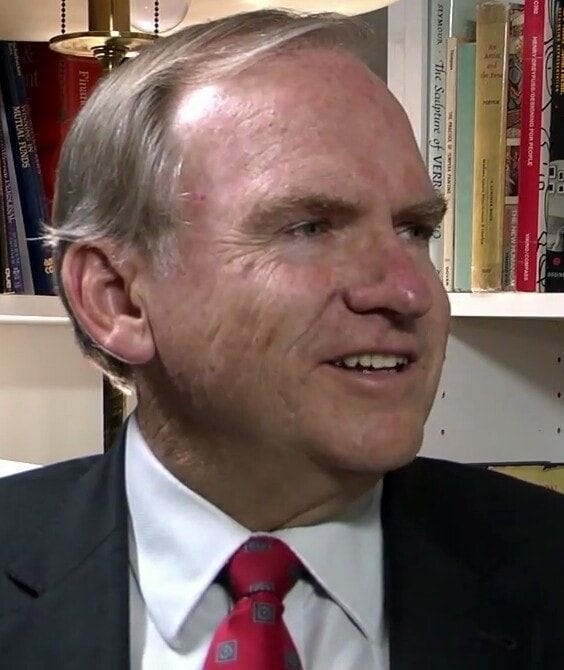

King is president of the New Mexico Children’s Foundation, according to the foundation’s own board listing and to Reuters.
Where the paper stops
The missing pieces are specific, and most of them are public records.
Maple’s $5,200 check is not in the release; JEGE’s is. Whether the other six September refunds cleared, and whether Indyke or Kahn’s firm were ever repaid, would show on bank statements and the 2015 filings. The Santa Fe County Sheriff’s 2010 registration file would date Epstein’s first appearance and show what he declared. The Department of Public Safety’s internal file for July 23 to August 19, 2010, including anything to or from the attorney general’s office, is the only record that could change the 2010 section, and a federal judge asked for part of it in 2019 and was given nothing. The 1993 deeds at the Santa Fe County Clerk would show who in the family signed. The land office would know whether 25 percent was ordinary.
What the documents do not show is a man running a trafficking operation, or a prosecutor burying a file.
What they show is money at every climb, Congress in 2004, attorney general in 2005 and 2006, governor in 2014, from the same office and the same address. A sitting attorney general’s office booking a meeting with a convicted sex offender the day after the state excused him from the registry, in the middle of the first trips he made to New Mexico after his lawyer said he had not been back. A campaign that put the multi-entity instructions in writing, asked for the plane, and paid the quoted fare four days after two of those entities sent $10,400. And a bank that could not describe four of Epstein’s companies except by pointing at him.
King said, in 2006, that he did not think he had ever met the man. The filings were already in Carlsbad. The meeting was four years away.
The full deep-dive behind this piece, with every citation, is published as Gary King, “I don’t think I’ve ever met him personally” on my site. Documents are reproduced from the U.S. Department of Justice Epstein release and from public filings with the Federal Election Commission. This article relies on several AI agents and assistants, primarily Claude Fable 5.1 which, like humans, can make mistakes. All claims are linked for easy verification by the reader.
Thanks for the comprehensive receipts, Rye. Excellent work. I remember Alisa raising this too—and I give credit where it’s due. These Deutsche Bank types need looking into. Keep digging.
Wow.🤩 Did you catch that his donor corps also owned his properties?