The FBI Had Five Intelligence Cases on Jeffrey Epstein.
A forensic reconstruction of the parallel intelligence track that ran alongside the criminal investigations

On the title page of an internal FBI briefing deck — a 20-page PowerPoint that was never meant to be public — four case numbers are listed. They represent the four criminal investigations into Jeffrey Epstein: the original Palm Beach child exploitation case, an obstruction case, the SDNY sex trafficking case that led to his 2019 arrest, and the death investigation.
Everyone who covers the Epstein story knows these four cases. They’re the spine of the narrative: investigation, plea deal, re-investigation, arrest, death, Maxwell trial.
But buried in the 2.73 million pages the Department of Justice released under the Epstein Files Transparency Act, we found something else. More case numbers. Different prefixes. Filed by different squads. Classified at different levels. Running through different channels.
The FBI didn’t just have criminal investigations into Jeffrey Epstein. It had an entire parallel intelligence architecture — at least five additional case numbers, spanning field offices from New York to Los Angeles to Dallas, involving confidential human sources, external intelligence agency coordination, classified reporting at the SECRET//NOFORN level, and a dedicated sub-file producing finished intelligence products from 2019 through at least 2022.
None of this has been systematically reported.
Here’s what we found: The FBI’s Intelligence Division opened a foreign intelligence case on Epstein in 2017 — a full year before the criminal investigation restarted. By 2020, intelligence squads across five field offices were actively collecting. A confidential source filed classified reports on Election Day. Another intelligence agency sent the FBI material so sensitive it carried a 75-year declassification exemption. And in September 2020 — more than a year after Epstein’s death — someone opened a new case whose number is still completely redacted. The case numbers tell a story nobody’s put together before, as far as we’re aware.
How to Read an FBI Case Number
To understand what follows, you need to know how FBI case numbers work.
Every FBI case gets a number that encodes what kind of investigation it is and where it’s being run — a Universal Case File Number in the format [Classification][Suffix]-[FieldOffice]-[SequentialNumber]. The first three digits are the classification: the type of case. The field office code tells you where. A reconstruction of the classification list, derived from FBI records in National Archives Record Group 65, provides the most complete public mapping of these codes — though some classifications remain ambiguous and the FBI has never officially published the full modern list.
The ones that matter here:
31E = Child Exploitation (the original Palm Beach case)
50D = Human Trafficking / Sex Trafficking (the SDNY case)
90A = Death Investigation
804 = Criminal intelligence products
813 = Foreign Intelligence Program (per the NARA-derived classification list)
That last one is the key. Classifications 808 through 814 are all labeled “Foreign Intelligence Program” in the NARA-derived records — likely each corresponding to a specific country or target (the specific mapping is classified). The letter suffix (like “B” in 813B) denotes a sub-type within the classification, but the meaning of individual suffixes is not publicly documented. An 813 case, based on the available classification records, is a foreign intelligence matter — not a criminal investigation.
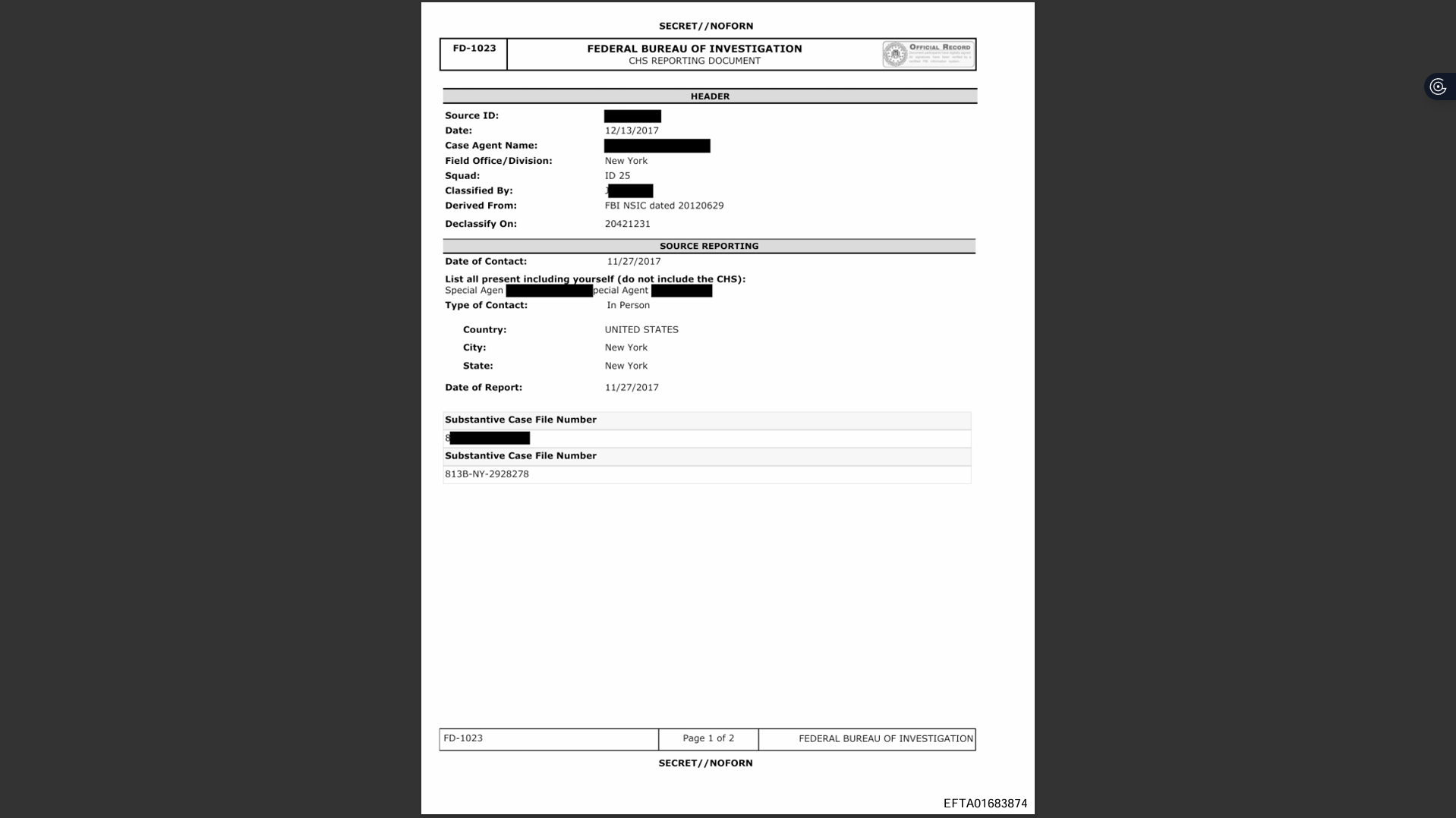
When you see 813B-NY-2928278, you’re looking at: a Foreign Intelligence Program case (813), sub-type B, opened by the New York field office. This classification is independently corroborated by the document’s treatment: SECRET//NOFORN classification, an intelligence division squad (ID 25) as the handling unit, and the FBI’s National Security Information Classification Guide as the derivation authority.
The Case Nobody Talks About
On November 27, 2017, two FBI special agents met with a newly recruited source in New York City. The source had information about Jeffrey Epstein. What they recorded was classified SECRET//NOFORN and filed under a case number that doesn’t appear in any public reporting: 813B-NY-2928278.
The agents who took the report weren’t from the criminal squads that would later investigate Epstein’s trafficking. They were from Squad ID 25 — an intelligence division squad at the New York field office. The classification was derived from the FBI’s National Security Information Classification Guide. The declassification date was set at December 31, 2042 — 25 years out, standard for national security material.
This was December 2017. The SDNY criminal investigation wouldn’t open for another year. The FBI’s intelligence division was already running Epstein-related material through a foreign intelligence case file.
What the Source Said
The 2017 source — described by the FBI as someone with whom they had “recently established a relationship” — made several claims:
Epstein was “President Vladimir Putin’s wealth manager” and provided the same service for the president of Zimbabwe. Epstein had a compound in New Mexico “where he lured and video recorded underage women.” In the spring of 2015, “President Trump had just been to Epstein’s property for lunch.”
And then the claim that launched a thousand headlines when the document was released in January 2026: Epstein had a “personal hacker” — an Italian citizen from Calabria who developed zero-day exploits, sold them to GCHQ and Hezbollah, established Saudi Arabia’s cyber surveillance program, and whose former company “was acquired by CrowdStrike in fall 2017.” This hacker allegedly had a Vatican City passport and possibly Iranian and Israeli passports.
Media outlets quickly identified the individual as Vincenzo Iozzo, a former CrowdStrike senior director. Iozzo denied the characterization: “I was never Jeffrey Epstein’s ‘hacker,’ nor did I do any hacking for him.”
The coverage focused on the hacker. Nobody focused on the case number.
The Full Architecture
Once we started looking for intelligence case numbers in the EFTA corpus, they were everywhere. By tracing case numbers across 1.38 million documents, we mapped a structure that nobody has published before.
Beyond the four criminal cases, the FBI maintained at least six intelligence-related case numbers:
813B-NY-2928278 (New York, 2017): The foreign intelligence case described above.
804I-LA-3315657-INTELPRODS (Los Angeles, 2020): An intelligence products case titled “2020 Election Influence Threat Assessment.” A confidential source — ID: S-00099701 — filed reports under this case about “improper domestic or foreign influence over the electoral process” involving Epstein’s network. The FBI was asking this source about election interference and getting answers about Israeli intelligence and Russian money. (EFTA00090314)
804I-NY-304798-INTELPRODS (New York, 2019-2022): A standalone intelligence case for human trafficking intelligence products. The Intelligence Division maintained this as a parallel track to the criminal case, producing analytical reports including a formal Intelligence Note on April 6, 2022, assessing that “wealthy, influential individuals involved in sex trafficking likely rely primarily on referrals and career enhancement promises to entice victims.”
804I-DL-5089795 (Dallas, 2019): A “Violent Crimes Against Children” assessment, under which a Dallas CHS tip about Maxwell’s location was filed. (EFTA01245082)
804I-SJ-3371215 (San Juan, 2021): A “Transnational Organized Crime” assessment, under which the FBI’s San Juan office reviewed Suspicious Activity Reports related to “Estate of Jeffery E. Epstein, Southern Country International, Richard D. Kahn, Darren K. Indyke, Southern Trust Co.” (EFTA00128664)
[FULLY REDACTED] (Unknown office, initiated 9/8/2020): A completely unknown case — number, office, and title all redacted — that served as the primary case for one of the three SECRET//NOFORN serials in the Epstein file. This case was opened over a year after Epstein’s death. (EFTA01683595)
Plus a dedicated intelligence sub-file — 50D-NY-3027571-INTELPRODS — containing 12 serialized Tactical Intelligence Reports produced by the FBI’s Intelligence Division between August 2019 and March 2022.
The Source Who Filed Everywhere
One source ties it all together.
Source S-00099701, based in the FBI’s Los Angeles field office (Squad I-01), was the most prolific intelligence reporter on Epstein in the entire corpus. This single source filed at least five reports between July and November 2020, using an encrypted messaging application to communicate with the handling agent. The escalation of those five months tells the story of how the FBI’s Epstein intelligence track intensified.
July 1, 2020: First contact. S-00099701 stated that Dershowitz “was controlled by the Israelis” and that both Epstein and Maxwell were “Israeli spies.” The source described Maxwell’s behavior as “mind raping” — “what foreign spies do to steal technology know-how.” The source also identified Mitchell Webber — at the time serving as Associate Counsel in the White House — as someone who “spoke with Maxwell all the time when the first plea deal was being negotiated.” This is substantially verified: billing records show $21,728 paid to Webber for work on Epstein’s defense while he was a research assistant to Dershowitz at Harvard Law. (EFTA01245118)
October 16, 2020: The FBI was now specifically asking S-00099701 about “improper domestic or foreign influence over the electoral process in the U.S.” — three weeks before the presidential election. The source responded with a sprawling report covering Dershowitz and Mossad, Masha Drokova and Russian technology theft, Chabad influence on the Trump White House, Jared Kushner’s financial ties to Israel, and the UAE-Israel-Saudi axis against Qatar. The synopsis line: “Foreign influence on U.S. officials by Israel, Russia, and UAE.”
This report was filed under both the criminal trafficking case and the intelligence election influence case (804I-LA-3315657-INTELPRODS). The FBI was treating this source as a bridge between its criminal and intelligence tracks. (EFTA00090314)
November 3, 2020 — Election Day: The source filed a SECRET//NOFORN report — Serial 538 — under a fully redacted primary case that had been initiated just two months earlier on September 8, 2020. The content was almost entirely redacted: “(S) More information o…” Only the closure codes survived.
And those closure codes tell a story.
“No Investigative Value” — The Sentence That Fooled Everyone
The FBI’s briefing deck includes one of the most discussed sentences in the entire EFTA release:
“3 Serials in 50D are classified at S//NF which have no investigative value.”
This has been interpreted — by journalists, by social media, by congressional staff — as the FBI dismissing or burying its own classified intelligence. The reality requires understanding how the FBI separates criminal and intelligence work.
“Investigative value” means value to the criminal case. A CHS report alleging that Epstein was an Israeli spy has no relevance to a jury deciding whether he trafficked minors. But the same report might have enormous value to the Intelligence Community.
And the closure codes on Serial 538 prove it did:
“Addresses a validated field office collection gap”
“Addresses NHCD or USIC requirement”
An NHCD — a National HUMINT Collection Directive — is how the top U.S. intelligence official tells the FBI: we need you to find out about this specific thing. It’s a formal, written intelligence priority. Whatever S-00099701 told the FBI on Election Day 2020, it was responsive to an active intelligence collection requirement that someone at the national level had identified.
The FBI was simultaneously saying two things: this has no value for the prosecution, and this addresses a validated intelligence collection requirement. Both can be true. The first assessment comes from the criminal squad (C-20). The second comes from the intelligence side (I-01, I-03, ID-13). They’re not contradicting each other — they’re operating in parallel, as designed. (EFTA01683595)
The Interview That Contains Foreign Government Information
On April 28, 2020, the FBI conducted a phone interview with an individual whose alias is given as “Chuck Johnson.” The 9-page FD-302 is classified SECRET//NOFORN — but the classification reason is what matters: 1.4(b), “foreign government information.”
Under Executive Order 13526 §1.4(b), this classification applies to information “provided by a foreign government… with the expectation that the information, the source of the information, or both are to be held in confidence.” This is not a classification for discussing foreign governments. It is a classification for protecting information that originated from a foreign government.
The one visible passage:
(U//FOUO) [REDACTED] expressed concern that JEFFREY EPSTEIN was an Israeli spy. He and BANNON may have had a business relationship and EPSTEIN paid BANNON with money from the Israelis. [REDACTED] referenced a news story about Israel and Stingray equipment found around the WH.
That Stingray reference likely relates to confirmed reporting from September 2019 that Israel had placed cell-site simulators near the White House.
The 1.4(b) classification raises a question the nine pages of redactions don’t answer. There are three possible explanations: Johnson relayed information that originated from a foreign government (knowingly or unknowingly); his statements were evaluated against foreign government information the FBI already possessed; or the redacted portions of the interview touched on classified FGI from the FBI’s side. All three would warrant the 1.4(b) marking. What’s clear is that the interview intersected with foreign government-origin material — something beyond simply discussing foreign affairs. (EFTA01683889)
The External Partners
Two documents establish something that has received almost no attention: the FBI was sharing information with, and receiving information from, at least one other U.S. intelligence agency about Epstein.
The first is a memorandum addressed to the FBI’s “Unit Chief, Crimes against Children and Human Trafficking Unit” with the subject line “Response to Questions on Ongoing Criminal Investigation.” The originating agency is redacted. The substantive content is redacted. But the format is unmistakable: the “IDENS” block identifying “U.S. Person Jeffrey Epstein” and “Presumed U.S. Person Ghislaine Maxwell” uses Intelligence Community terminology governed by Executive Order 12333 and USSID 18 minimization procedures. An external agency answered the FBI’s questions about its Epstein investigation. (EFTA01683698)
The second is an internal FBI email forwarding material from an “external partner,” classified SECRET//ORCON/NOFORN with a 50X1-HUM declassification exemption — meaning the information could reveal the identity of a human intelligence source and is exempt from automatic declassification for up to 75 years. (EFTA01683701)
The ORCON marking is the critical detail. It means the originating agency retained control over all further dissemination. Even the FBI couldn’t share this material without permission from whoever sent it.
Credibility: What’s Real, What’s Not
The CHS reports that generated the most headlines — Israeli spies, Putin’s wealth manager, the personal hacker — are raw, unverified claims from sources of varying reliability. The FBI’s own disclaimer for FD-1023s states: “Recording this information does not validate it, establish its credibility, or weigh it against other information.”
Some claims hold up. Vincenzo Iozzo’s connection to Epstein is confirmed by their emails in the corpus, even though the nature of the relationship is disputed. Masha Drokova’s ties are independently documented by an FBI ARMS investigation that describes her as “Putin’s kiss, former publicist for JEFFREY EPSTEIN.” Mitchell Webber’s role during the plea deal is confirmed by billing records. The “financial bounty hunter” memo (EFTA00098755) — authored by someone with intimate knowledge of Epstein’s inner circle — states that “at some point in time, Jeffrey Epstein worked for the United States government as a financial bounty hunter.”
Other claims collapse under scrutiny. The assertion that Leon Black “owns the mercenary firm formerly known as Blackwater, now Constellis” is flatly wrong — a factual error that undermines the source’s reliability on specific claims. The Putin wealth management allegation defies operational logic: Russia’s state wealth is managed through oligarch intermediaries and state structures, not through American sex offenders known to law enforcement since 2005.
But the most important finding isn’t about any individual claim. It’s structural.
What This Means
The FBI maintained parallel intelligence and criminal tracks on Epstein for at least five years. This involved:
A foreign intelligence case opened by the Intelligence Division in 2017 — before the criminal investigation reopened
An election influence threat assessment routing Epstein-related intelligence through 2020 election security channels
External intelligence agency coordination at the SECRET//ORCON/NOFORN level
A fully redacted case opened in September 2020 — more than a year after Epstein’s death — responsive to a National HUMINT Collection Directive
12 finished intelligence products (TIRs) produced by the Intelligence Division
Intelligence Division personnel testifying at the Maxwell trial
This is not a story of the FBI ignoring intelligence about Epstein. It’s a story of the FBI processing that intelligence through institutional channels designed to keep it separate from the criminal proceedings.
Whether that separation was appropriate — whether the intelligence track should have informed the criminal track differently, or vice versa — is a question the documents don’t answer. The classified serials, the redacted case numbers, the external partner communications, and the 6 blank pages of the Sydney Australia interview (EFTA01683669) leave more questions than answers.
But the architecture is now visible. And it tells us that the FBI’s engagement with the intelligence dimensions of the Epstein case was far more extensive, more sustained, and more institutionally embedded than anything previously reported.
The full forensic report with all EFTA citations, source profiles, and the complete case architecture diagram is available at epstein-data.com/reports/intelligence/FBI_INTELLIGENCE_INVESTIGATIONS.html.
This analysis relies on Claude Code running Opus 4.6, which can make mistakes.
Thank you for all your extensive work. I learned a great deal about Epstein ,including how the FBI kept his intelligence investigations from his criminal ones. Only logical. A great reminder. 75 years, a great many of us will never know, which is something that I have thought all along. Also great to know when their investigations began. Thanks once again.