

Every document quoted here is linked. Most are short. You should read them yourself.
On January 4, 2026, the Office of the Deputy Attorney General sent the lawyers reviewing the Epstein files a memorandum. It is titled Attorney Review Protocol for Epstein Files. It is nine pages long. The Department published it. It may be the most useful document in the whole fight, and almost nobody treated it that way.
Page two tells reviewers how to sort what they are looking at.
There are five choices for responsiveness tags in the review platform; please choose only one tag for each document.
Responsive—apply this tag if a document relates to any of the nine topics above
Non-responsive—apply this tag if a document does not relate to any of the nine topics above
If non-responsive, move on to the next document (i.e., no need to apply redactions or any other tags)
Duplicate—apply this tag if the document is a duplicate. For example, if the document is an email chain and the most-inclusive email (i.e., containing all the back-and-forth) has already been reviewed and redacted as appropriate for production, the interstitial back-and-forth can be marked as duplicates. This is also the case for any materials already publicly released through official channels; for example, the Department’s prior release of the flight log, contact book, and masseuse list.
If a duplicate, move on to the next document (i.e., no need to apply redactions or any other tags)
Error—apply this tag if there is a technical issue with viewing the document
Foreign language—apply this tag if a document is in a foreign language
Read that again. Of the five doors a document can go through, exactly one leads into the process Congress designed. The other four end the review. Move on. No redactions. No other tags.
This matters because the Epstein Files Transparency Act’s entire accountability machinery hangs off a single hook. If you black something out, you must write a justification, publish it in the Federal Register, and send it to Congress. A document tagged Duplicate never gets a black box. So it never gets a justification. So it never appears anywhere a member of Congress, a judge, or a reporter could count it.
The Department collected more than six million pages and published just shy of 3 million. The gap is the story. Most of it went through those four doors. There is no public record of a single one of those decisions.
That is why there is a sequel. And the sequel does not close those doors.

What Congress actually authorized
The first law is simple enough to hold in your head, which is what makes the rest of this legible.
Public Law 119-38 passed the House 427 to 1, cleared the Senate by unanimous consent the next morning, and was signed by President Trump on November 19, 2025. Section 2(a) lists nine piles of records that must go online in thirty days, searchable and downloadable: everything on Epstein, everything on Ghislaine Maxwell, flight logs, named officials, entities tied to the trafficking or financial networks, immunity and plea deals, internal charging decisions, any paper trail about destroyed files, and the records of his detention and death.
Section 2(b) forbids withholding anything because it is embarrassing, damaging to a reputation, or politically sensitive, and names government officials, public figures, and foreign dignitaries so nobody can miss the point.
Section 2(c) lists the five things that may be blacked out. Victim identifying information. Child sexual abuse material. Anything that would jeopardize an active federal investigation, narrowly and temporarily. Images of death or injury. Properly classified national-security information.
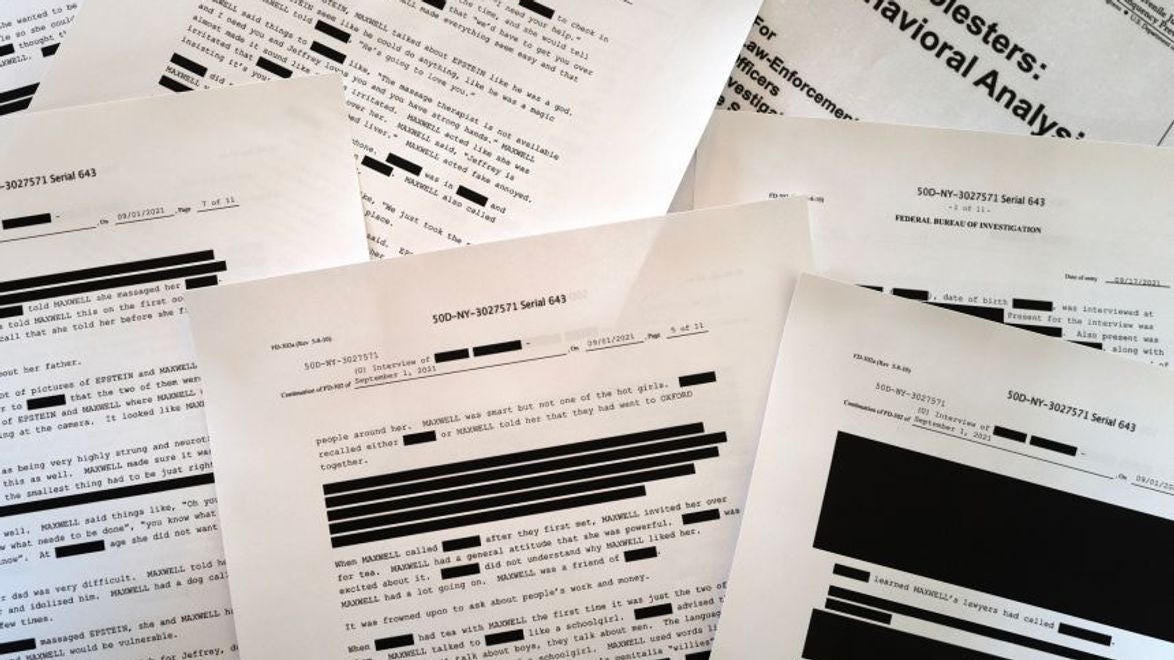
Then the sentence everything now turns on:
All redactions must be accompanied by a written justification published in the Federal Register and submitted to Congress.
When a statute enumerates exceptions, the ones left off are excluded. Congress does not have to write “and nothing else.” Writing five is writing “and nothing else.”
What the law did not contain was a plaintiff. No private right of action. No standing for a survivor who wanted her own FBI interview report, or a state prosecutor building a case, or a member of Congress who suspected cheating. A mandate with a deadline and no consequence is a request.
The footnote I would put on a billboard
Go back to the protocol. Second footnote, page five:
One thing to note is that victim records—e.g., school, immunization records, yearbooks—should be treated as non-responsive rather than responsive. Therefore, for those records, there is no need to apply redactions.
Look at what that does. A teenager’s yearbook is obviously protectable. The statute has a door for exactly that: Section 2(c)(1)(A), covering victims’ personal files whose release would be an unwarranted invasion of privacy. Using that door protects the victim and creates a countable, justified, published record that something was withheld.
The protocol routes them through the other door instead. Same protection. No paperwork. No entry in any log. Nobody outside the building ever learns those pages existed.
I want to be careful here, because this is where it would be easy to overclaim. Nothing in that footnote is evidence of bad faith toward victims. Protecting a yearbook is the right instinct. But it is a perfect miniature of the structural problem. When an agency has two routes to the same outcome, and one generates an audit trail while the other does not, watch which one the manual recommends.
The same memo also defines who counts as a victim. Not only people identified in the Epstein and Maxwell prosecutions. Also anyone who has “directly or through counsel been identified, including self-identified, to the Department as potential victims of state or federal offenses or other claims of sexual exploitation or misconduct by Epstein or Maxwell.” That is a wide net. It is not a magic switch that lets a public figure disappear from the files by calling himself a victim of the disclosure. Section 2(b) still forbids reputational protection. But once a name is on the confidential list, reviewers are told to redact it and the context around it. That process has power. A court can test a particular redaction. It cannot test a page that was never tagged responsive in the first place.

What the Department said, in its own numbers
The Department has been unusually forthcoming about the shape of what it kept. That is what makes the arithmetic possible.
Its December 19, 2025 letter to Congress says the Department solicited names from victims’ counsel and that “this process resulted in over 1,200 names being identified as victims or their relatives.” It says that because of broad collection, “the vast majority of the items that components provided to JMD were non-responsive under the Act.”
The same letter is where the Department wrote down its legal theory of privilege:
These privileges are based in common law—not statutes—and Congress is fully aware of them.
That is a real argument. Courts do presume Congress does not abolish established common-law doctrines by accident. It is also an admission that the Department added a withholding ground Congress did not list.
The January 30, 2026 letter, signed by Attorney General Pam Bondi and Deputy Attorney General Todd Blanche, puts a number on that pile:
In total, approximately 200,000 pages have been redacted or withheld based on various privileges.
The same letter concedes an entire category simply went unreviewed. The collection “included pages in various foreign languages.” Because it was “not practicable for a first-level reviewer to determine” what they were, they, along with the files the platform could not ingest, were set aside. Those are not exceptions in the statute. They are the Error and Foreign Language tags, at scale.
The Department’s January 30 press release lists what it held back in four buckets, in its own words: duplicate documents between the New York and Florida investigations; material withheld under deliberative-process and attorney-client privilege; depictions of violence; and items “not part of the case file for Epstein or Maxwell.”
Of those four, exactly one appears in Section 2(c).
The table the Department did not have to publish
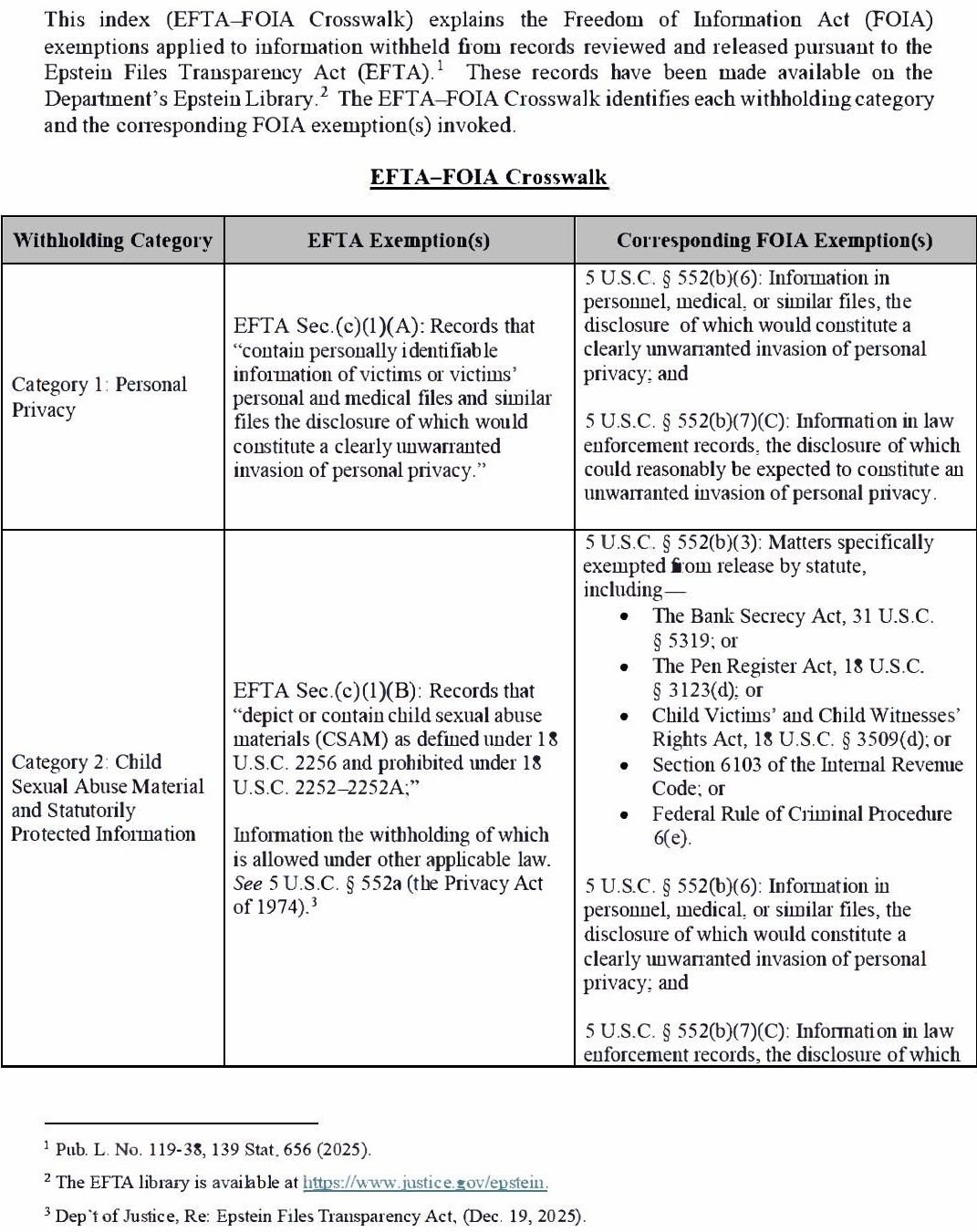
Some time after the release, the Office of Information Policy posted an EFTA–FOIA Crosswalk — an index mapping each withholding category to a Freedom of Information Act exemption. Nothing in the law asked for it.
The first rows behave. Category 1, personal privacy, cites EFTA Section (c)(1)(A). Category 3 cites (c)(1)(C). Category 4 cites (c)(1)(D). Each points at a subsection Congress wrote.
Then Category 5, headed Privileged Information. In the column marked “EFTA Exemption(s),” where every other row names a provision of the law, this row names no provision of the law at all. It says “Information privileged under the common law,” lists the three privileges, and footnotes not the Act but the Department’s own February 14 report to Congress.
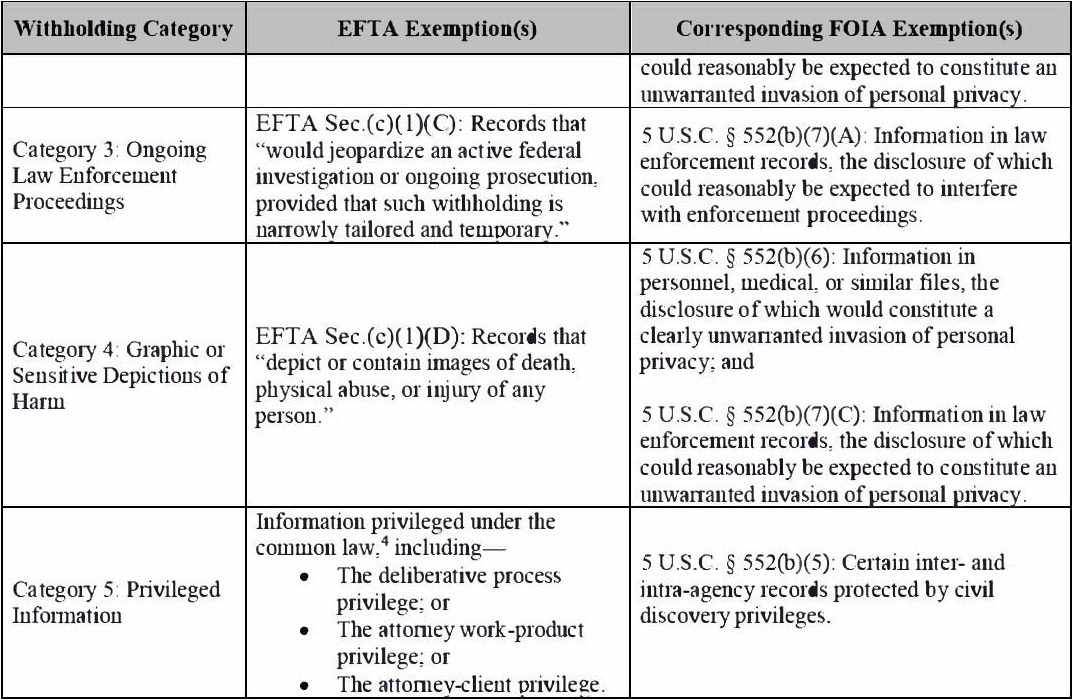
This is not a leak. An office whose job is explaining FOIA posted a table in which the legal-authority column goes blank at the exact moment the withholdings get interesting.
There is a further problem with the whole exercise, and a federal judge has already flagged it. The Crosswalk translates a standalone disclosure statute into FOIA’s much roomier exemption scheme. FOIA has nine exemptions and a generous view of internal deliberation. The Epstein Act has five and no such view. When the Department argued in court that FOIA was the proper vehicle here, Judge Emmet Sullivan disagreed. The heading in Phang v. Blanche reads, flatly, that FOIA does not provide an adequate remedy.
A journalist sued. The Department declined to argue.
Because the Act gave nobody standing, the journalist and attorney Katie Phang had to sue under the Administrative Procedure Act, the statute you reach for when Congress forgot the remedy. The case is Phang v. Blanche, No. 26-1417.
On June 25, 2026, Judge Sullivan granted a preliminary injunction. Phang made five arguments that the Department had broken the law, including that it had never published any redaction log. The Department’s brief answered none of them. It argued only that she had no right to be in court. Sullivan applied the local rule that unaddressed arguments are conceded:


By not responding substantively, the Attorney General has conceded Ms. Phang’s merits arguments in the pending motion.
And again, in the section refusing the Department a stay:
The Attorney General has conceded that he is in violation of the Act.
The December letter had promised only that “[a] privilege log will be produced in due course.” The redaction log is a different document, and Sullivan noted the Act had required it by December 19, 2025, “more than six months ago.” The bond he set was one dollar.
The Department did not lose a fight about whether it complied with the law. It declined to have the fight.
On August 27, 2026, eight months after the deadline and two months after the injunction, the Department finally published a notice in the Federal Register, signed by Associate Attorney General Stanley E. Woodward, Jr. What it published is a description of “all categories of records released and withheld” and “a summary of the redactions made.” A summary. By category. That is exactly what “All redactions” permits.
Two words, and a sentence that answers a sentence
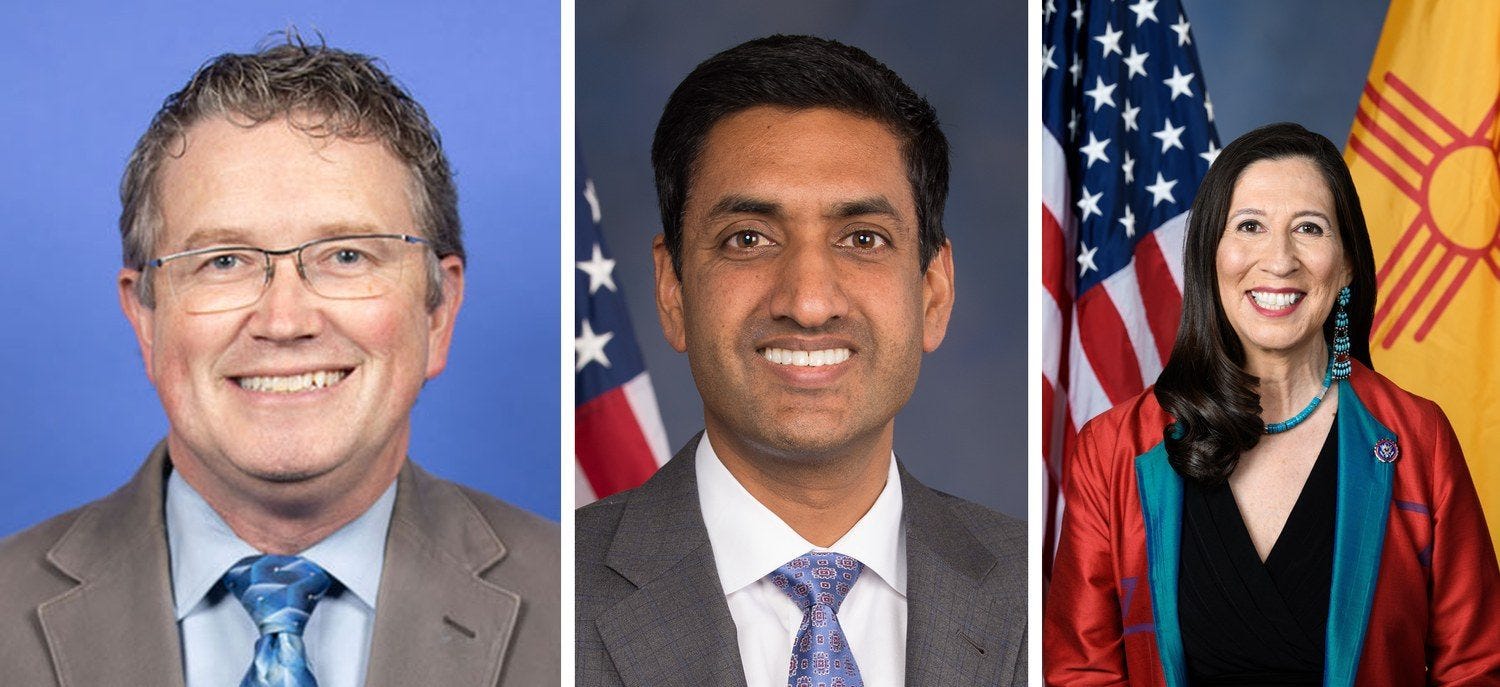
H.R. 9694, the Epstein Files Transparency Act II, was introduced July 15, 2026 by Reps. Thomas Massie, Ro Khanna, and Teresa Leger Fernández, with a Senate companion from Jeff Merkley and Ben Ray Luján. It reads like a document written with the Department’s letters open on the desk.


The smallest change is the one that would generate the most paper. Section 2(d) of the bill amends the original Act by striking “All redactions” and inserting “Each redaction.”
That is the entire amendment.
“All redactions must be accompanied by a written justification” can be read collectively: the redactions as a body need a justification, and one document covering the set will do. Or distributively: every black box needs its own reason. The Department chose the collective reading and, in August, filed a category summary. “Each redaction” makes that reading impossible. It turns a summary into a ledger, one line per bar, across millions of pages. The pattern across those lines is where anything hidden would become visible.
Good transparency drafting does not out-muscle an agency. It takes away the sentence the agency was standing behind.
The privilege ban is the same kind of answer. In December the Department said the privileges were common law and Congress had not spoken clearly enough. The bill adds a new paragraph to Section 2(b):
The Attorney General of the United States may not invoke any common law privilege, including the deliberative process privilege, attorney-client privilege, attorney work-product privilege, or law enforcement privilege, to withhold, delay, or redact any record, document, communication, or investigative material described in subsection (a), except as expressly permitted under subsection (c).
That is not a slogan. That is a sentence drafted to answer another sentence. Two hundred thousand pages sit on that exchange. Note also what else got closed. The Department has not leaned on law-enforcement privilege in the Crosswalk. The drafters banned it anyway.
The rest of the bill, more briefly. State attorneys general, district attorneys, survivors, and individual members of Congress all get a cause of action against the attorney general. On the state side the bill spells out what counts as harm, and the list is disjunctive: investigative harm, harassment, inability to corroborate reports to law enforcement, inability to obtain a victim statement, “informational injury,” or “financial harm in excess of $100.” Any one of them will do, and the hundred dollars attaches only to the financial item.
Survivors can demand their own unredacted files, with FD-302 files named specifically, though the Department may still redact other victims’ identifying information out of them. If DOJ doesn’t comply, the survivor can sue. Any member of Congress can demand full unredacted access to any covered record within seven days. State prosecutors get the real stack, with the Touhy regulations switched off and a clause titled “No limitation to in camera review.” Four criminal statutes are pointed at Department and Bureau officials, with the attorney general and FBI director named in the text, though each statute’s existing intent requirement still has to be met.
The definition of “victim” is doing quiet work, and it is worth reading slowly. A person qualifies only if they were directly harmed by the abuse. That is the gate. A separate exclusion bars anyone whose claim of being a victim arises from their own participation in, facilitation of, concealment of, or benefit from the conduct, unless their involvement began with being trafficked or abused themselves. So this is not a door a redacted public figure can walk through. Inside that gate, though, the bill says a person counts as recognized if the Department has “identified, designated, recognized, or otherwise treated” them as a victim, “including by redacting such individual’s name or personally identifiable information in a record.” The black box becomes proof the Department knew. It cannot redact your name and then tell you it never designated you. Being named in an FD-302 file works too, and so does a sworn declaration.
The bill also deletes the classified-information exemption and, in a new Section 4(d), requires the attorney general to give state attorneys general full unredacted review of classified records in a secure facility. He “may not refuse, delay, or object to access … on the grounds that the material is classified.” That sentence will end up in front of appellate judges. In Department of the Navy v. Egan (1988), the Supreme Court said the authority to protect classified information falls to the president as commander in chief. The same opinion acknowledges Congress’s power to legislate in the area. So this is a real fight, not a slogan. It will be had by a Department that has already shown it prefers arguing about jurisdiction to arguing about compliance.
What the sequel does not fix
Go back to page two of the protocol.
EFTA II amends Section 2(b), Section 2(c)(1), Section 2(c)(2), and adds a new Section 4. It never touches Section 2(a), which defines what is covered. Every fix in the bill operates downstream of the responsiveness decision. Non-responsive, Duplicate, Error, and Foreign Language all sit upstream. After the sequel, exactly as before, a document tagged Duplicate generates no redaction, no justification, no Federal Register line, and no ledger entry.
And we know that door has already swallowed things it should not have.
In March 2026 the Department acknowledged that about fifteen documents had been incorrectly coded as duplicative. Among them were FBI interview summaries with a woman who told agents in 2019 that she had been abused by Epstein and assaulted by Donald Trump in the 1980s, when she was between thirteen and fifteen. Officials first said the missing summaries were duplicates. A follow-up review found they were not. Reuters and CNN reported the release. Trump has denied the allegations, and news organizations have reported that they could not independently corroborate them.
This is proof of something more useful than a mere cover-up. The tag with no paperwork produced a false negative, and the only reason anyone found out is that someone outside the building noticed a gap. The Department itself later said, in a social media post reported by ABC News, that five prosecution memos “initially withheld as privileged communications” could, after all, be “released while still protecting the privileged materials.” Both of the Department’s extra-statutory mechanisms, Duplicate and Privilege, have already generated documents that had to be walked back.
The forensic question worth asking is not only “why did you redact X?” It is: give us the disposition table for all six-million-plus collected pages. Unique ID, source, responsiveness code, duplicate-of ID, reviewer, timestamp, privilege code, withholding code, production Bates number. Without that, outsiders are auditing the output while the Department controls the discard pile.
Then there is Category 2, and this is the part that still is not getting enough air.
Everyone looks at Category 5 because it is visibly improvised. Look at Category 2 instead. Its heading in the Crosswalk is “Child Sexual Abuse Material and Statutorily Protected Information.” The first half is the statute. The second half is a bucket the Department added in the same cell: “Information the withholding of which is allowed under other applicable law.” The FOIA column invokes exemption (b)(3) and names the Bank Secrecy Act, the Pen Register Act, the Child Victims’ and Child Witnesses’ Rights Act, Section 6103 of the Internal Revenue Code, and Federal Rule of Criminal Procedure 6(e).
The protocol is blunter than the table. Its last page carries a short list headed Other. Two of its items:
Tax records: for tax records generally, redact only to the extent it reveals PII. If the “tax record” is a tax return, choose “z_Redacted in Full” and make a note of it in the “RN-Redaction” freeform text field.
SARs: redact; choose “z_Redacted in Full” and make a note of it in the “RN-Redaction” freeform text field.
Redacted in full — not segregated, not case by case. A blanket rule for an entire class of financial evidence, in an investigation whose governing statute expressly covers “entities with known or alleged ties to Epstein’s trafficking or financial networks.”
Now read the sequel’s ban one more time. It prohibits any common-law privilege. Deliberative process, work product, attorney-client, and law-enforcement privilege are judge-made doctrines, and the bill kills all four. The Bank Secrecy Act is a statute. Section 6103 is a statute. Rule 6(e) is a rule of criminal procedure. None of them is a common-law privilege. The ban does not reach a single one.
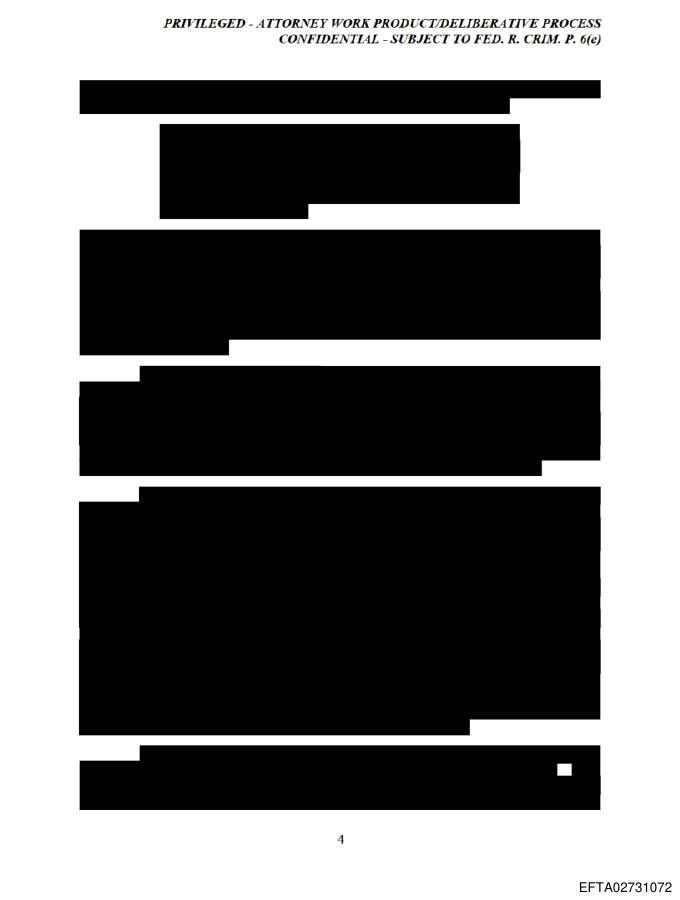
These are not hypothetical categories. A Southern District of New York memorandum on whether to prosecute Epstein-related corporate entities was released with a Rule 6(e) stamp across the header and nine of its thirteen pages solid black; an 86-page companion on potential co-conspirators carries the same stamp and goes dark for eleven straight pages at the section deciding whether to charge anyone. Suspicious activity reports are Bank Secrecy Act documents.
Some of those underlying secrecy laws may well survive a standalone disclosure statute, and Congress may not have displaced them. That is a real legal question. It is also an aggressive interpretive move: Congress wrote five exceptions; the Department constructed more from common law and from other statutes, then mapped the whole arrangement onto FOIA in a table it did not have to publish.
So if EFTA II passes tomorrow, the door marked privilege is welded shut, the door marked classified is taken off its hinges, and the doors leading to the grand-jury material and the money are still standing open, in a row of the table that says CSAM on the front.
Two more, briefly. The active-investigation exception is untouched, and the Department controls both whether an investigation exists and how long it lasts. And the criminal penalties, which name the attorney general and the FBI director, would be enforced by federal prosecutors who work for the attorney general. There is no independent counsel in the bill.
Where it stands
The bill sits in the House Judiciary Committee. On August 31, Massie opened a discharge petition, the same maneuver that forced the first law onto the floor, and began collecting the 218 signatures that would take the decision away from leadership. He needs a handful of Republicans to reach 218, assuming Democrats hold.
The coalition is thinner than last fall. Massie lost his Kentucky primary on May 19 to a Trump-endorsed challenger. The author of both bills is a lame duck. Marjorie Taylor Greene, one of the four Republicans who signed the first petition, announced her resignation days after that vote and left Congress in January.
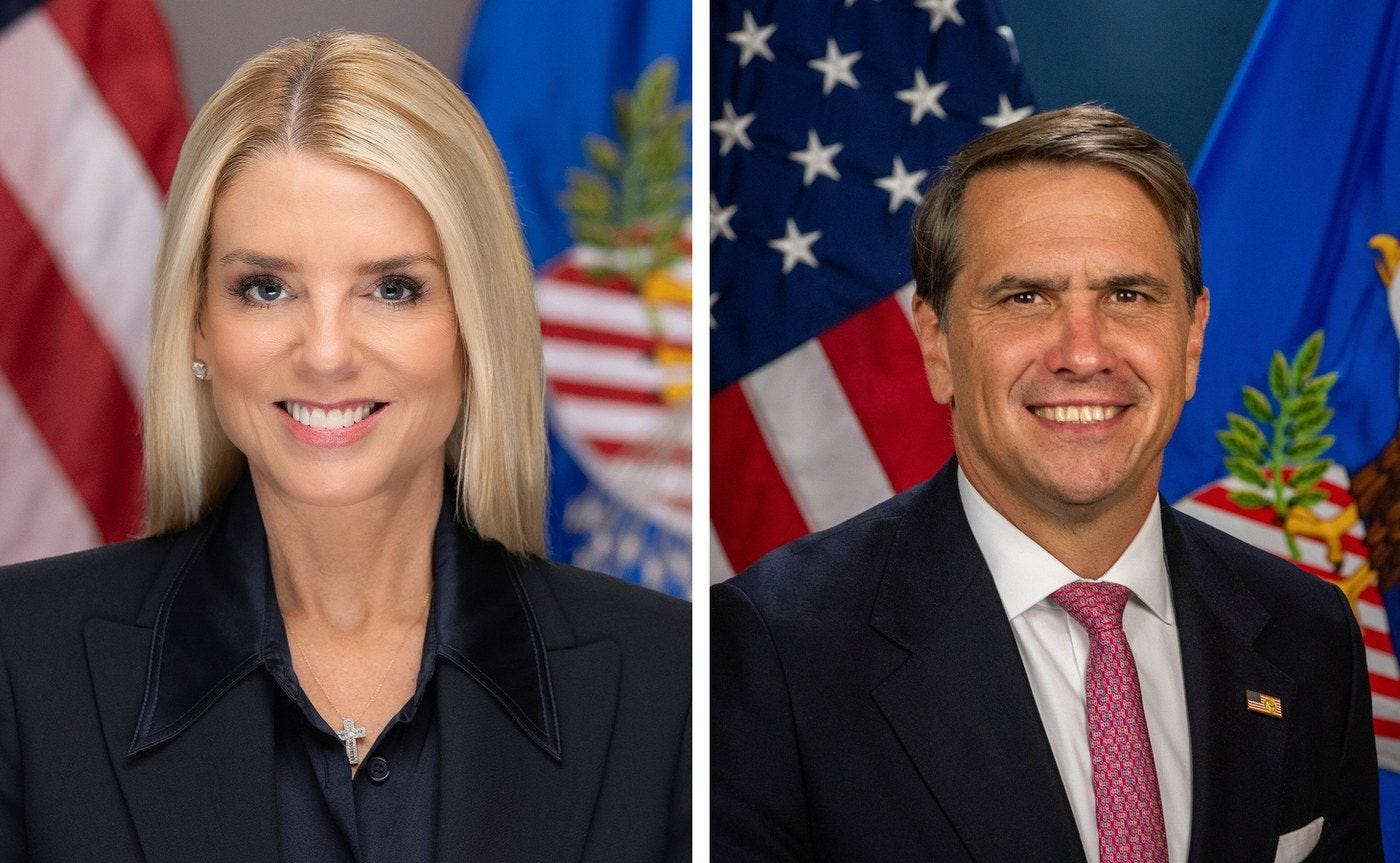
Pam Bondi was removed as attorney general in April. Todd Blanche, who had been Trump’s criminal-defense lawyer, runs the Department in an acting capacity. He is the named defendant in the case where his lawyers declined to argue the merits.


The Department’s inspector general opened an audit in April of exactly these questions: how records were identified, collected, and produced; how withholding decisions were made; how the Department responded when problems surfaced. It has not reported.
Maggie Haberman and Jonathan Swan, in Regime Change, have reported that Trump made clear to his aides that he had no interest in releasing anything related to Epstein and that senior officials spent the summer of 2025 managing the political fallout. That is evidence about pressure and incentives, but not, by itself, evidence that the review conducted after the law passed was manipulated. The stronger material is procedural, and it is all in the Department’s own documents: a protocol that ends review before the statute’s paperwork begins; a legal theory that adds privileges Congress omitted; a table that cites “the common law” where a statutory citation should be; fifteen documents that had to be walked back from Duplicate; a judge who found the Department had conceded it was in violation; a Federal Register notice that is still a summary.
What this actually is
Three things.
The Department wrote it all down. Nobody leaked the review protocol. The Department published it as part of its own compliance response. Nobody stole the Crosswalk. The Office of Information Policy posted it. Agencies under pressure generate documents to look responsive, and those documents are routinely more candid than anything anyone would say aloud. The paper trail here, whatever it turns out to mean, is a set of public PDFs with footnotes.
The most powerful line in the sequel is a grammatical correction. The right to sue deserves its headline. Survivors deserve their FD-302s. State attorneys general deserve the stack rather than a guided tour. But, at least as a data scientist, “All redactions” becoming “Each redaction” is what converts a category summary into a document that has to run to millions of lines. The Department spent eight months not producing that document. When it finally filed in the Federal Register last week, it filed a summary.
And the shape of it will repeat. In round one, every exception Congress instrumented went unused, and every path Congress left uninstrumented absorbed the traffic. The Department says it withheld nothing as classified, the one exemption carrying published justifications, named classifying officials and a declassification duty, and routed millions of pages through Duplicate, Non-responsive, Error, and Foreign Language, which carry nothing at all. EFTA II closes the doors that were used. It does not close the doors that weren’t.
The next one is already visible. It is on page two of a memo the Department published itself, and it says move on.
Corrections and document tips welcome. The government documents cited here are U.S. government works. The court opinion is a public filing. This article relies on several AI agents and assistants, primarily Claude Code using Opus 5 which, like humans, can make mistakes. All source documents are linked for easy verification by the reader.
Primary sources
Attorney Review Protocol for Epstein Files (Jan. 4, 2026)
Thanks Rye! Great article! Let’s hope the amendment to this Epstein Act goes through so at least the states can do more about this by independently bypassing this corrupt DOJ and White House!
United States of Corruption