

Read the last page of the transcript first.
A House Oversight lawyer quoted Jes Staley’s own words back to him, a statement he had once written to the trustees of Bowdoin College: “At no time after his conviction in 2008 did I allow J.E. any connection with any aspects of my professional life.” Then she answered it with the record. You asked Epstein for advice on your salary. You shared confidential information about your deals. You told him about your meetings with government officials. You gave him updates on your Barclays hiring process.
“If you were comfortable lying before, how do we know you’re not lying to us now?”
Staley: “I’m not lying to you.”
The interview ended at 5:46 p.m.
The thing that made the wires that afternoon was the confidential information. Staley, who once ran JPMorgan’s investment bank, told Congress he had fed Jeffrey Epstein the kind of material a banker is not supposed to share with anyone: the bank’s communications with the Federal Reserve, a moment in 2008 when “the Private Bank has brought in $44 billion dollars in the last two weeks,” his own pay negotiations with Jamie Dimon, and deals he was working on. A registered sex offender was getting a running feed from inside one of the largest banks in the world.
Here is who was doing the feeding. Jes Staley spent decades at JPMorgan, ran its investment bank and asset management arm, left for a hedge fund, and became chief executive of Barclays in 2015. He resigned as Barclays CEO in 2021, and British regulators went on to ban him from senior roles in UK finance after finding he had misrepresented how close his relationship with Epstein had been. JPMorgan separately sued him under the “faithless servant” doctrine to claw back years of pay, saying he had failed to report his own conduct and had vouched for Epstein’s character. His July 24 interview was voluntary and not under oath, a point Democrats on the committee stressed the day he walked in.
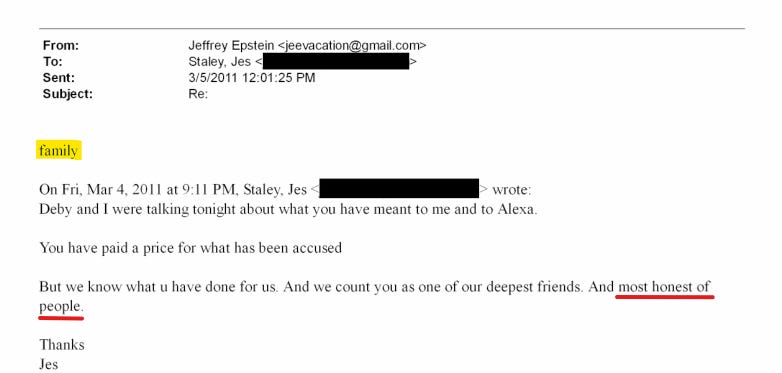
But the confidential information is not the sharpest thing in the file. The sharpest thing is a sentence Staley wrote to Epstein on March 5, 2011, almost three years after Epstein pleaded guilty to soliciting a minor:
The words he chose
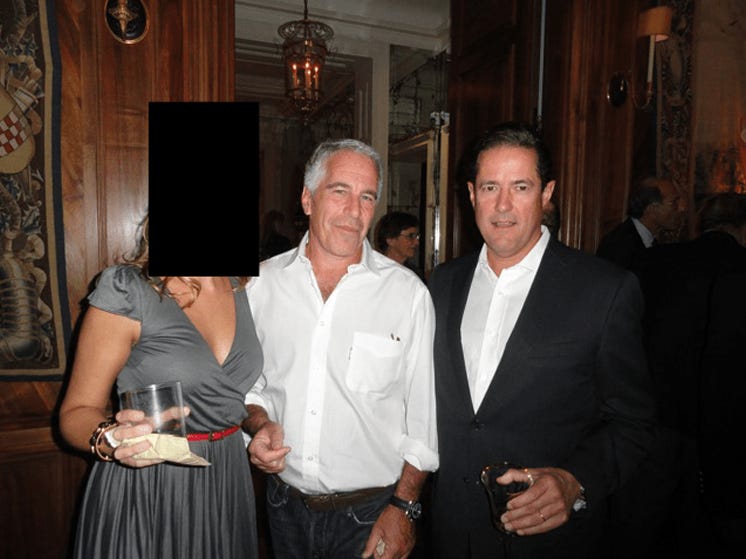
Staley told the committee he and Epstein were in contact roughly weekly. The emails in the Justice Department corpus show what that closeness sounded like, and every one of them came after the guilty plea.
December 2009: “It was great to be able, today, to give you, in New York City, a long heartfelt hug. To my friend, Thanks.”
March 2011, the full note: “Deby and I were talking tonight about what you have meant to me and to Alexa. You have paid a price for what has been accused. But we know what u have done for us. And we count you as one of our deepest friends. And most honest of people.” Epstein’s recorded reply was a single word: “family.”
That is the moral frame. The Bowdoin sentence is the fact it collides with. Because the same corpus holds the emails Staley told the college never existed. In November 2009 he forwarded Epstein a live Dubai sovereign-finance deal, naming officials at the Dubai Department of Finance, with one instruction: “Please use with discretion.” In July 2015, as he prepared to take over Barclays, he emailed Epstein, “The CEO wants to meet.” The message carried JPMorgan’s standard stamp marking it confidential and potentially “inside information.”
Live deals and his own move to run a bank. That is precisely the “connection with aspects of my professional life” he swore to a board of trustees had ended in 2008.
What he knew in 2006
The most important document the committee produced is an internal JPMorgan email from July 26, 2006, three days after Epstein’s first arrest. Mary Erdoes, head of the Private Bank, forwarded Staley a colleague’s note linking a Palm Beach Post article, with the comment “So painful to read.” Staley wrote back: “I went and saw him last night. I’ve never seen him so shaken. He also adamantly denies the ages.”
The article he was reacting to described a college student who “gave Epstein a massage in the nude, then brought him six girls, ages 14 to 16,” and quoted Epstein saying he would pay for more, “the younger, the better.”
Asked to explain his own email twenty years later, Staley did the committee’s work for it. “I think he denied the ages, which, you know, looking back, is an admission of guilt.” Could Epstein have honestly mistaken a 14-year-old for an adult? Staley said no. Then: “I think I gave him the benefit of the doubt.” A year later, describing a Hamptons party to Erdoes, he wrote that “the age difference between husbands and wifes would have fit in well with Jeffrey. What a joke.”
The defender in the room
By 2011, JPMorgan’s own lawyers wanted Epstein gone. That October, General Counsel Stephen Cutler told Staley that Epstein “was not an honorable person in any way, and should not be a client.” Staley’s response, in his own account: “I let the bank do what the bank felt was proper.” He then suggested Cutler sit down with Epstein and his lawyers, Ken Starr among them, before deciding anything. On the large cash withdrawals compliance had flagged, Staley passed along Epstein’s explanation without pushing back: the money was “for fuel for his airplane.”
The cleanest contradiction came live, on Ghislaine Maxwell. Staley said, “I don’t believe I had interaction with Ghislaine Maxwell,” and could not recall recommending an account for her. The committee handed him an internal JPMorgan record reading: “Jes Staley has also met with her and has recommended we open an account for her.” Shown his own recommendation, he said only, “I don’t [recall],” and confirmed the bank opened the account.
This is the conduct JPMorgan itself later put in a lawsuit, calling its former executive a faithless servant.
The allegation
One survivor’s allegation runs through the file, and it has to be stated carefully, because that is its status. An internal Southern District of New York note from December 2019 reads: “one of the non/minor Epstein victims alleges that Jes Staley… raped her during a massage.” The committee entered the underlying prosecution memo, which describes an adult survivor whom Epstein “instructed… to provide a massage to Jes Staley,” and who told law enforcement she was then assaulted.
Staley denied it flatly. His counsel stated on the record that the complaint “was not found credible.” A committee member responded that they had “credible information that you have aggressively, even violently, sexually assaulted multiple women connected to Mr. Epstein.” That question is unresolved.
Staley did give his own account of one encounter. He acknowledged a single sexual relationship with a member of Epstein’s staff, which he described as consensual and as involving “a mature woman,” and which he treats as entirely separate from the assault the survivor alleges. Both accounts agree the woman was an adult. They disagree completely on consent. Readers deserve both versions side by side, which is why they are here.
The pattern
There is one correction worth making in Staley’s favor, because getting the small things right is how you earn the big ones. The famous November 2009 email (“I’m in the hot tub with a glass of white wine… I owe you so much”) was long assumed to have been written on Epstein’s island. Staley told the committee it was Epstein’s ranch in New Mexico, after a business trip to Albuquerque. The documents do not settle it, so it stays contested.
The committee also left something on the table. For years, across two employers, Epstein served as Staley’s back-channel adviser on Asia, counseling him on a possible move of JPMorgan’s investment bank to Singapore and on winning the country’s sovereign wealth fund as a client. None of it came up. It is documented separately, in the Singapore investigation.
But the shape of the thing is not in doubt. A registered sex offender was, for more than a decade after his conviction, described by one of the most senior bankers alive as a deepest friend and the most honest of people, fed confidential information from inside two banks, and defended in the room when compliance wanted him out. Staley wrote that description himself, in 2011. He has now given his account of the relationship to a British regulator, a college board, and the United States Congress. The documents were released the same week. You can read both and decide which one to believe.
The full report, with every document linked to its page in the archive, is here. The sexual-assault allegation is reported as an allegation: it is denied, and Staley’s counsel stated the underlying complaint was “not found credible.” This article relies on several AI agents and assistants, primarily Claude Opus 4.8, which can make mistakes. All source documents are linked for easy verification of claims.
Still just scratching the surface I believe, but y’all keep on digging. Thank you for acknowledging judicious use of AI assistance. **edit** and providing source document links!
That a liar continues to lie is not up for debate. What is debatable is the cover up that has ensued for at least a decade and probably longer. Trust your own instincts people because you can’t now trust the FBI or the present administration whom have usurped them. They are all trying to save their own skin by sticking “to the plan.” They know if one goes down they all go down. Don’t let them slide just because they are rich and influential.