

When you report that a Washington Examiner journalist posted a protected abuse survivor’s unredacted FBI notes and then handed another withheld file to a stranger, the first fair question is: how do you know? This is the evidence file behind that story. The forensics that authenticate the documents, the timestamps on the government’s own servers, the tell hidden in a web archive, and the questions still sitting unanswered in an inbox.
This is a companion to the main investigation, Conservative Journalist Shared Unredacted Trump Accuser FBI Notes That DOJ Hasn’t Released. If you haven’t read that yet, start there; this piece assumes it.
How we know the notes are likely real
Coverage hedges on whether the leaked notes are authentic. That question can almost certainly be put to rest.
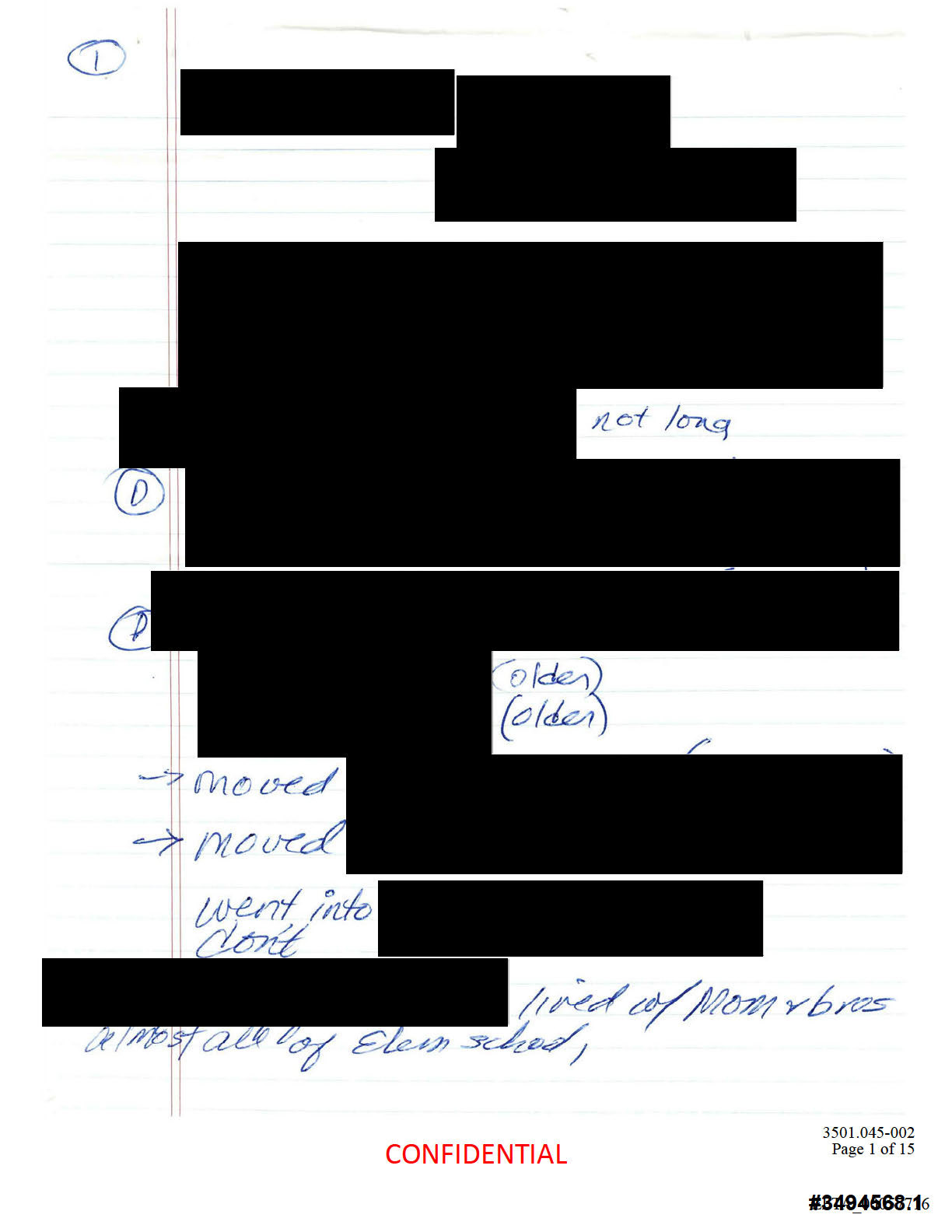
The three note-sets are one export. Every one carries the same signature: produced by a tool called OpenPDF 3.0.0, saved as PDF version 2.0, pages normalized to US Letter, and titled with an internal case-management ID in the #number.version form a legal document-management system assigns, not the Bates number a government production uses. Their creation timestamps fall inside a single fourteen-second window on March 6, 2026, at 15:20:03, :10, and :17 UTC, which is 10:20 a.m. Eastern. That is the morning after the DOJ released the redacted typed versions.
A genuine DOJ production file looks nothing like that. We pulled a stratified sample of 35 files, three from each of the twelve released datasets, straight from justice.gov, and cross-checked independently hosted copies from multiple sources. All 35 carried the identical signature: PDF 1.5, no producer, no title, no embedded dates, native scan sizes. A bare, metadata-stripped scan container. The leaked notes match that on almost nothing.
However, none of that makes the content fake. It means the container was rebuilt. We compared the content of the handwriting against the DOJ’s own released 302s line by line, and the accounts track beat for beat, the typed reports often fuller. The words are the government’s. Someone re-wrapped the pages and stamped them, all three, in one sitting, the day after the government released the typed set it called complete.
Two more things corroborate the exchange independently. In the Signal screenshot, the file Deese sends is marked 5.1 megabytes, the exact size of the unredacted first-interview PDF that Document Zero has in its possession, received with the same filename. The account depicted as volunteering the “source within DOJ” line is also Deese’s verified X account.
What the DOJ’s own servers show
The government’s web server stamps every file with a last-modified date, and past the site’s age gate those are checkable by anyone. The Jane Doe files went up on March 5, release day, and stayed frozen there. With one exception. The typed report of the second interview, the one describing the assault allegation, was modified again on March 19, two weeks later, as if the department had gone back to work on it. Everything else stood still. Only that one moved.
The tell in the archive
Deese keeps his source documents on Scribd, a running library under the handle reportoftheday; a second account runs in his own name. The uploads track his bylines: a Biden ghostwriter transcript, a Boulder hate-crime affidavit, an FBI document on the Clinton campaign. Each one sits beneath a story he wrote.
When Deese embeds a document, web archivists find it within a day. His Clinton document ran November 13, 2025, and the Wayback Machine grabbed its Scribd page on the 14th. The two Jane Doe note-sets, on the other hand, sat unarchived for months. No article pointed to them, no link, no crawler, until summer. A file nobody links is a file nobody is being sent to read.
What’s in the notes, and what isn’t
Here is the part that matters for anyone tempted to treat the notes as a suppressed trove. They are not one. The substance of what the woman told agents is already in the typed 302s the department released in March. We compared the two directly. Every major thread in the handwriting, the babysitting arrangement that first brought her in, the Hilton Head villa, the university dean she says she saw with Epstein, the Polaroids, the decades of threatening phone calls, is in the government’s own summaries, often in fuller form. The notes are the agents’ scratch paper, not a second story.
Their one unique payload is the thing we will never print: the identities the 302s were built to hide. The survivor’s legal name, her children’s names, her parents, and the friends and neighbors she named as possible witnesses, all of it in the clear on the version that sat on a public document host for five months. That is the harm here. Not new evidence getting loose, but a protected woman’s name getting loose. It is why we have not linked the files or named a single person in them.
The witnesses the 302s hid
That payload is not trivial. The Charleston Post and Courier, whose reporters Marilyn W. Thompson and Mitchell Black reviewed about thirty pages of the notes, found the agents had written down the names of possible corroborating witnesses, including women the accuser said were at a pool party, that never made it into the released 302s. At least one of those women told the paper the FBI never contacted her.
Those are the pages that put the department in front of a judge. In June, in the lawsuit brought by journalist Katie Phang, U.S. District Judge Emmet Sullivan found the government likely in violation of the Epstein Files Transparency Act and ordered it to produce the underlying notes or explain why they could not be redacted by hand. The statute, he noted, has no exception for “duplicative” documents. That was the department’s entire argument.
The torch
The path these files traveled is its own small map of how buried material reaches daylight, and of who does the careful work along the way. They surfaced not through any newsroom but through a reader: Amy Gabrielle, who writes the Substack Absolute Pleasure, found Deese’s two Scribd uploads, posted screenshots to r/Epstein and published her findings in an article in the small hours of August 18. A second member of the public (‘ReZeroForDays’) reverse-image-searched those screenshots back to the files, pulled the two documents, messaged Deese, and was handed the third. Ellie Leonard, who had been reporting the Jane Doe material, was contacted by ReZeroForDays and brought the thread to me. ReZeroForDays redacted them first, by their own account, hastily. That is more than the reporter who originally posted them can say.
The seven questions
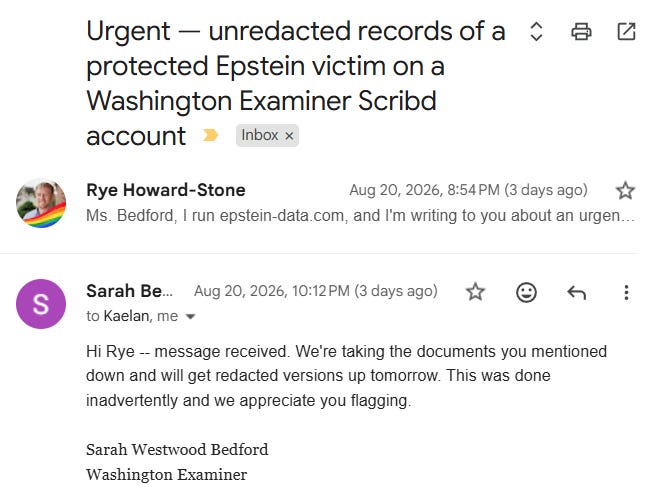
We put six questions to Deese and to Sarah Bedford, an Examiner editor, in writing on August 21. Bedford had replied the night we first flagged the documents, 78 minutes later on a Thursday evening at 10:12 PM — the paper was taking them down immediately, redacted versions would follow, and “this was done inadvertently and we appreciate you flagging.”
Those two Scribd addresses now resolve to the DOJ’s properly redacted, typed versions, while the upload date still reads March 6. The questions themselves are still unanswered on the record:
Did he upload the files, and when?
How did they come into the paper’s possession?
Were they posted with a story in mind, and if so, why was none published?
What did the paper do to verify them?
Why were they posted unredacted?
Does the Examiner have a position on naming sexual-assault victims who have never come forward?
After ReZeroForDays/‘Nunya Business’ supplied me with the screenshots, I forwarded them to Bedford and Deese along with an addendum:
Are these screenshots authentic?
None of those is a trap. A clean answer to any one of them would change this account. The inbox is open.
The way you publish a withheld page
There is a real argument for printing what the department called duplicative and a judge has since ordered it to produce. Transparency laws are not suggestions, and handwritten notes can hold a name or a lead a typed summary sanded off. The Post and Courier proved exactly that by finding the witnesses the 302s hid.
There is also a way to do it. You use the redaction the department already applied to the typed reports. You do not put a protected survivor’s legal name, her children’s names, and her friends’ names on a public document host. And you do not leave the file sitting there, unlinked, for a season, and call that publishing.
Deese had the documents. He had the beat. On March 7 he even had the story about the hole those documents belonged in. He wrote the hole. He posted the pages. When a stranger came asking, he sent more. The one thing he never did was write the story.
Read the main investigation: Conservative Journalist Shared Unredacted Trump Accuser FBI Notes That DOJ Hasn’t Released.
Kaelan Deese and the Washington Examiner were asked for comment; this piece will be updated with any on-the-record reply. The allegations against Donald Trump described in the FBI materials are uncorroborated; he has denied them and has not been charged. We have not published, linked, or reproduced the handwritten notes, or anything that would identify the woman who sat for those interviews.
I am impressed with how you research all this.
Good job Rye. Saw you on Substack the other day with Ellie. She trusts the source. I can see why.