What if it weren't?
600 applications, two interviews, zero offers. Plenty of scams.

I graduated with a PhD in Computer Science in December 2025, after nearly 6 years of studying Bioinformatics at the University of Connecticut. A few months into my second semester, COVID-19 lockdowns began, and we went remote. A few months later, while lockdowns were still in place, I had to move back with my mom: her cancer had progressed, and she needed help my brother could no longer provide. By the time she died, it was too late for internships. My thesis was ready to be assembled, my final paper submitted, and preparations for life after grad school began.
I started sending job applications daily about a year ago, 6 months before I was set to graduate. That seemed like sufficient lead time, at the time — if I had a few weeks of a gap after graduating, that seemed only reasonable after so many years of essentially working two demanding full-time jobs.
A year later I’ve sent over 600 applications. Everything ranging from diligently researched cover letters with customized resumes and CVs, to tapping every relevant “Easily Apply” button on Indeed and LinkedIn my thumb could find. I even wrote my own program to turn Claude into a ‘career coach’ that helped me identify and pre-fill applications to relevant positions using research often repackaged and sold as ‘elite’ methodology (the research is publicly available).
These efforts have produced exactly two job interviews; one at Anthropic for a Performance Engineer position, and another at a biotech firm called Recursion for an Agentic Systems position. As you can probably guess, I got neither job. In the meantime, I’ve been rejected from positions for which I would humbly posit I am overqualified — ‘college grad’ roles that require only a bachelor’s degree (I have two: physics and math), Junior software engineering positions, even unpaid internships. I began programming computer games at the age of 8 giving me, technically, 25 years of experience in software engineering. More recently, I built epstein-data.com which includes a free AI chatbot integration, semantic search, and reverse image search. Regardless, I’ll take an unpaid internship if it gets me a foot in the door and a path to a career. I stopped filtering for companies whose values match mine months ago — I've applied to defense contractors, banks, even freaking Palantir. I’ve probably applied to a job in every US state; I’ll relocate without assistance, if need be. No matter the compromises I make, I cannot seem to get an offer.
So imagine the utter rage I feel when the only responses to my resume look like this:
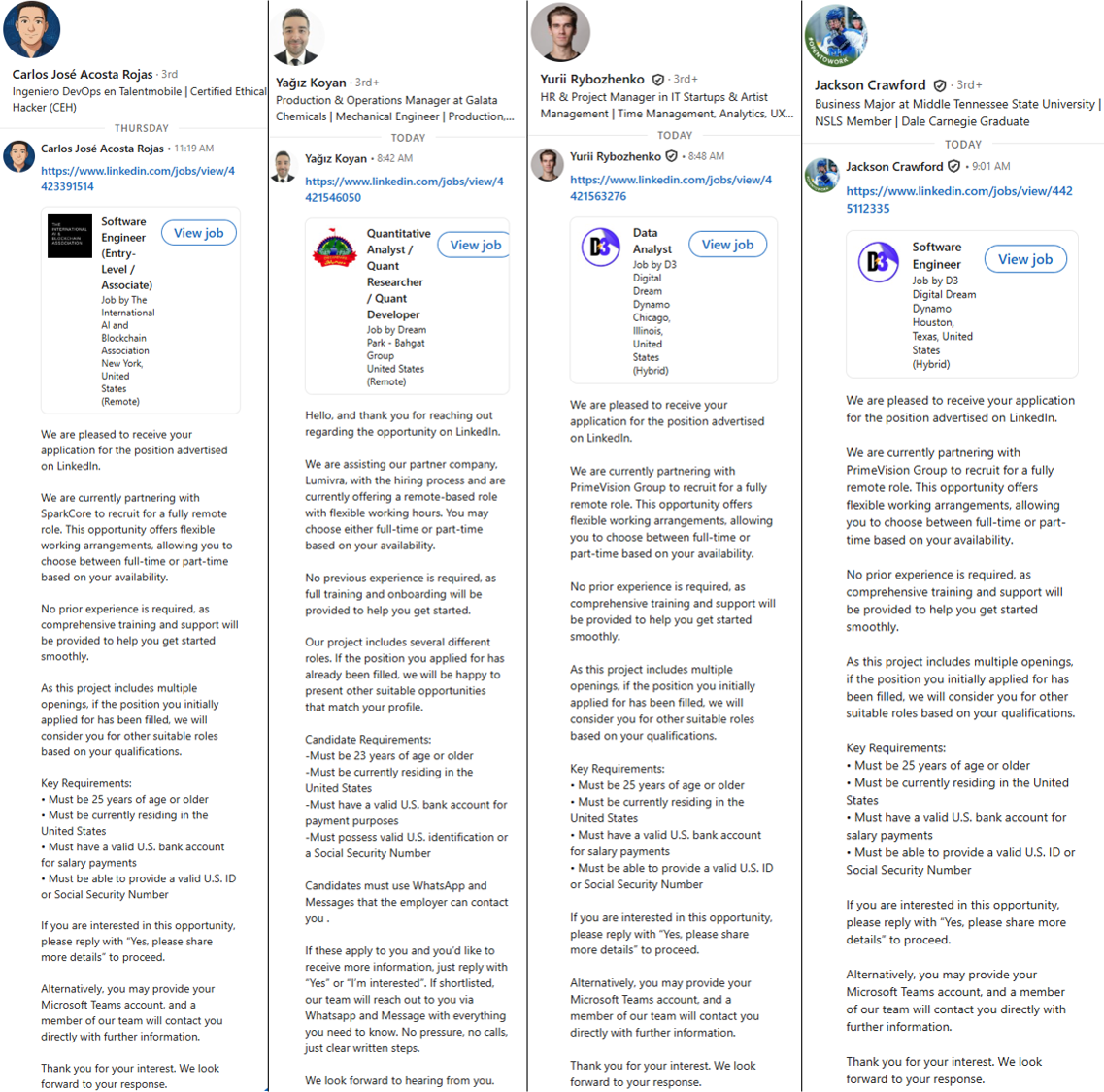
I’m a millennial; I grew up dodging scams. I knew what these were before I received 10 identical messages, before I’d even finished reading to the end of the first one.
That didn’t help the impulse to follow the lead — what if it weren’t? What if they really did need my SSN, bank account info, and address? It’s just a background check, right? If they really didn’t require any experience, I should be a shoo-in, right?
This job market is the surface upon which these scams prey. They know a significant percentage of people are getting desperate. For money, for purpose, for paths they were promised they’d get if only they could keep their heads down and work hard for long enough. That is how these scams work, that is why they exist.
My story is not unique; thousands of graduates are struggling to find positions. According to the New York Fed, unemployment among recent college graduates was about 5.7% in Q1 2026, while underemployment was 41.5%. The Fed defines underemployment as graduates working in jobs that typically do not require a college degree. I suspect these numbers are undercounting (people who’ve stopped applying may not be captured, gig work may mask underemployment further), but however you slice it, a large share of people who did what they were told to do — finish school, build skills, earn credentials — are either unemployed or working jobs that do not require the education they just spent years obtaining.
For software engineers and, really, anyone whose job occurs primarily on a computer, this job market is incredibly rough. Layoffs from major firms have resulted in an inflation of skill; we’re not competing against our former classmates, we’re competing against people with 25 years of work experience who’ve been laid off from Oracle or Microsoft. Those seeking employees can afford to be picky. I don’t blame them, I don’t know who to blame. I don’t know that assigning blame is all that helpful, anyway.
I do know that some unfortunate percentage of my position-seeking peers are going to fall victim to these scams — the scammers are counting on the fact that after 600 applications, two interviews, and zero offers, the question “what if it weren’t a scam?” starts to sound less like naivety and more like the only rational thought you have left.
So here is my warning: if a recruiter asks for your SSN, bank account, ID, WhatsApp, or “salary payment” information before a real interview, stop. Verify through the company’s official site. Do not reply inside the thread.
And here is my ask: if you’re hiring for AI systems, data engineering, scientific software, search, performance engineering, or research tooling, I’d like to talk.

This is another reason why grandmas’ hearts are breaking. Our most brilliant, hardworking, compassionate young people can not find the employment they have rightfully earned. Smart young people may now need to find a societal niche need to fill, in order to be gainfully self employed. Please help this brilliant and generous young man however you can.
Epstein-data is brilliant. Contract analysis is a good field. NDAs and non-compete clauses are keeping witnesses silent, and could use examination. 🧐 Have you looked at Research firms? Or start one and maintain your independence? Just ideas -