“Yes, My Method”
Michael Wolff is the sole gatekeeper of 100+ hours of Epstein tapes. I asked him about the emails showing how that access was obtained, protected, and used. His response? "I'll stand by my methods."

On April 30, 2026, Michael Wolff posted a teaser for an episode of Inside Trump’s Head, the Daily Beast podcast he co-hosts with Joanna Coles. The teaser said Donald Trump and Jeffrey Epstein had both wanted to sleep with Princess Diana and had turned the pursuit into a competition.
A commenter asked underneath:
Wolff replied with some of his patented smarm:
I commented underneath that. Not to own anyone in the comments, to ask the obvious next question. Wolff has stated publicly, on the record, that he holds more than 100 hours of taped interviews in which Jeffrey Epstein discusses the inner workings of the Trump white house. The DOJ Epstein-files release this year contains his own correspondence with Epstein: floating ways to “neutralize” Tina Brown and following up with “I’ve made a few inquiries about Tina and Wayne Barrett” (EFTA02020413), telling Epstein to pay off a doorman who appeared to have leaked his meetings with Steve Bannon to Page Six (EFTA01007038), routing a New York Magazine fact-check through him (EFTA02505950, EFTA02506485), and killing the resulting piece in coordination with Epstein (EFTA02394877). Some of it is hard to fit inside the category of “journalist and source.”
A note on what isn’t in that list. In my original comment thread under Wolff’s post I also cited two further emails — EFTA02542984 and EFTA02540766 — as Wolff “implying tapes as press leverage.” On rereading the underlying texts, those emails are about something else: Wolff using Epstein as a back-channel to Steve Bannon during Fire and Fury launch week, asking Epstein to mention to Bannon that Wolff had tapes of his Bannon interviews so Bannon would not publicly deny being a source. Different story, also notable, not this one. The four items above stand.
What followed was, by a wide margin, the strangest public exchange I have ever had.
This is not about whether Wolff is allowed to write about Epstein, or whether journalists should publish their raw notes. The first is obvious; the second is usually no. It is about custody and provenance: how an archive of this scale was produced, and whether the person asking readers to trust his narration was also a participant in the story he now claims to explain.
Wolff kept replying. Credit there — most writers at his level do not engage with random commenters at all, much less with receipts being posted at them. He answered every reply. And with each answer, the defense narrowed.
…being presented. I'm not a television personality. My interviews weren't made to be broadcast. They were made to aid me in telling the Epstein story, which I have written about extensively in the past, and which I am now telling on a strict timeline from when I met him until he died, on Substack, a new chapter every Monday. I think you'd find it interesting.”
“I’m the sole gatekeeper”
Wolff’s first move was the standard one. Raw files are not truth. Police archives should not be dumped online. His interviews were made to help him tell a story, not to be broadcast. He’s writing it chapter by chapter on Substack. Read it here.
That argument is not frivolous. Journalists do not publish their notes. Raw recordings can mislead. Victim privacy is real.
The argument is also not the question.
The question is whether Wolff specifically — given what his own emails show — should be trusted as the unilateral decision-maker on what more than 100 hours of historically significant material does or does not become.
So I asked him about July 20, 2011, when he wrote to Epstein that there were “lots of ways to neutralize her.” The “her” was Tina Brown.
He replied:
Two things about that reply.
First, “neutralize” did not mean killing Tina Brown. It meant killing a story. Two days after Wolff used the word, he wrote to Epstein: “I’ve made a few inquiries about Tina and Wayne Barrett” (EFTA02020413). Plural. Inquiries on two working journalists.
Second, “neutralize” was already operational vocabulary inside Epstein’s circle. Tina Brown herself, writing in The Daily Beast, documented a March 2011 message in which Epstein’s publicist Peggy Siegal asked Epstein how he might “neutralize” Brown — roughly four months before Wolff used the same word in his email to Epstein. By September, Epstein was writing back to Wolff: “Tina Brown / newsweek / daily beast, is the one left standing... however Wayne Barrett, an abusive reporter, has been getting help from some, to try to make trouble” (EFTA01853550).
I even asked:
So the question is simple: under what circumstances would you submit the tapes to an independent review process, with victim privacy protected? NARA, Hoover Institution archives, Schlesinger Library? Or, are we supposed to accept that the sole gatekeeper of historically significant Epstein material will be someone who also helped Epstein manage his image?
When I pressed, Wolff escalated to the line that anchors the rest of the exchange:
He was answering a question about whether he had been helping manage Epstein’s press image. The answer was about who owns the tapes.
“Yes, my method”
The fact-check sequence is the part of the record I find hardest to reconcile with the description of “journalism.”
In the Epstein files, you can see his interactions with Epstein for yourself. Ellie Leonard has compiled these into its own library of sorts, which I have also set up on my website with audio playback.
On March 30, 2015, at 4:04 PM, Wolff emailed Epstein. Subject line: “fact check.”
I just spoke to the fact checker, and what you can expect him to do is just go through pretty much every detail and assertion of the piece and ask if its true. This is partly because I’ve said I’ve kept no notes or tapes, so you need to be the source. (EFTA02505950)
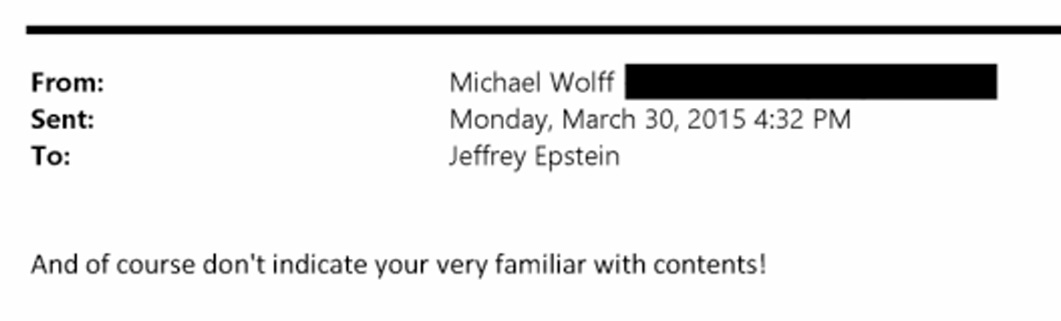
Twenty-eight minutes later, he sent a follow-up:
And of course don’t indicate your very familiar with contents! (EFTA02506485)
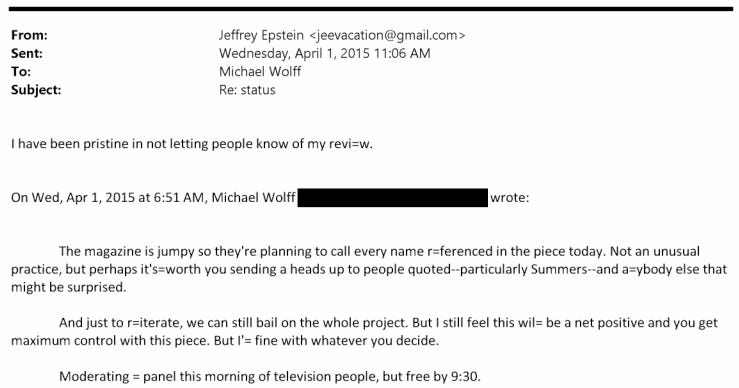
Two days after that, Epstein replied:
I have been pristine in not letting people know of my review. (EFTA01732263)
The method, in this case, was:
(1) send the unpublished article to your subject for review; (2) tell NY Magazine's fact-checker you’re keeping no notes or tapes; (3) coach the subject to lie about having seen the piece; (4) the subject confirms compliance.
When I pointed this out in the comments, Wolff replied:
The conduct happened before publication. The piece not running is not a defense of the method. It only means the method failed. Saying the goal was Bill Gates explains the incentive. It does not change what was done in pursuit of it.
The phrase at the end — “Yes, my method” — was offered as an answer.
I went on to point out what his method appeared to be:
mislead the fact-checking process if it helps land the bigger target.
But, the ends never came.. Bill Gates did not go on the record. The piece did not run. Only the means remain.
“And that then becomes the story”
When I noted the means had not accomplished the purported ends, Wolff replied:
He did not seem to mean it as a concession. But it was closer to the central issue than he appeared to realize.
He had named the actual problem.
The story is not whether Michael Wolff is abrasive in comment sections. Lots of writers are abrasive. Some of them brand it.
The story is that one of the most prominent claimants to inside knowledge of Jeffrey Epstein appears in the released record as someone who advised Epstein on managing the press, helped him route a fact-check around the magazine he was writing for, and killed the resulting piece in coordination with him.
“I was afraid, actually”
The piece died.
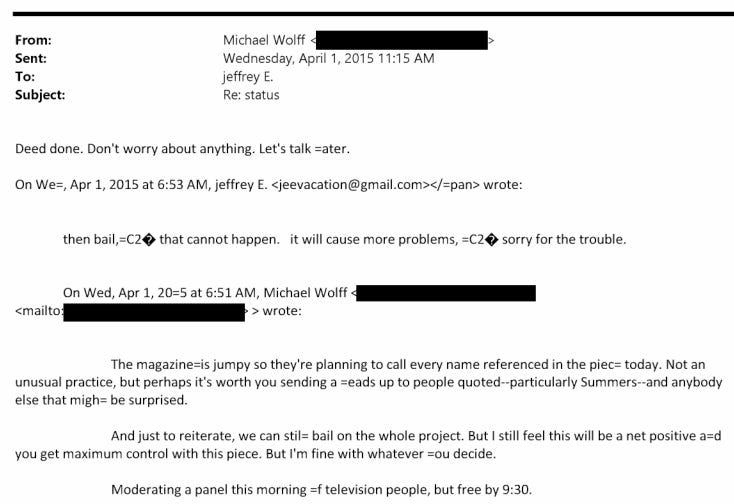
The kill is also in the released emails. Wolff offered to “bail.” Epstein replied “then bail.” Wolff replied “Deed done” (EFTA02348907, EFTA02507866, EFTA02394877).
…the Epstein story to “a rather preposterous fantasy of moral certainty”, after pointing out to the reader that “in New York … soliciting sex with anyone over the age of 14 is a class D misdemeanor calling for a $100 fine”.. i.e., an Epstein reputation rehabilitation piece. You then publicly told the New Yorker Radio Hour you killed it because “I was afraid, actually.”(wnycstudios.org/podcast…) ..Do I have this right?
So again: what is the story? Did you kill the piece because you were afraid of the forces around Epstein, as you later told the New Yorker Radio Hour?
Or was the piece killed after coordination with Epstein over problems that would arise if the jumpy magazine were to call names referenced in the piece, after a draft that plainly sought continued access to him?
It seems to me, whatever the story is, it bears directly on your credibility as the person now asking readers to trust your sole control over 100+ hours of unreleased Epstein material.
Years later, on The New Yorker Radio Hour, David Remnick had asked Wolff about a New York Magazine piece on Epstein that had not run. Wolff’s public explanation was different:
I decided I didn’t want to do it because I was afraid, actually... The intensity of issues that seemed to converge on anyone who was talking about Epstein, anyone who might have known Epstein, was just something I thought life is too short.
Two accounts of the same kill. The public one is fear of Epstein’s world. The private one is the email thread above.
The unpublished draft is also now public, through House Oversight (HOUSE_OVERSIGHT_022746). Its closing line:
Anyway, I hope I get invited back to Jeffrey’s house soon.
Earlier in the same draft, Wolff notes for the reader that:
in New York … soliciting sex with anyone over the age of 14 is a class D misdemeanor calling for a $100 fine.
The piece reflects on:
the limitation of journalism, in which the most compelling parts of the tale … need to be sacrificed not just to moral certainty but to a rather preposterous fantasy of moral certainty.
That is not the voice of someone afraid of Epstein’s world. It is the voice of someone worried about losing access to it.
That same person is now the sole gatekeeper of more than 100 hours of unreleased Epstein interview tapes.
This is not an argument for dumping raw audio online. Nobody serious wants that. Victim privacy is real, raw material can mislead, and “release everything” is more of a slogan than a strategy.
It is an argument that one person should not be the sole arbiter of an archive of that potential significance — least of all the person whose own correspondence shows him at times less like an independent journalist than like a participant in the room he is now offering to narrate.
I did ask for comment
After the exchange, I sent Wolff a note:
Hi Mr. Wolff,
First off, I do want to thank you for your candor and willingness to engage. You are one of very few public figures, I imagine, who would be so forthright and responsive to a random internet commenter. I think that’s to be commended.
Second, I was wondering if you’d be okay with me writing up a short Substack piece on our exchange? I found it rather enlightening, and I think my (admittedly meager) subscriber base would agree.
Thanks again,
-Rye
The comment exchange had unfolded with replies often arriving within minutes.
The permission email got no reply.
I do not need permission to write up a public exchange. I asked anyway, given the subject. He chose not to answer.
That, too, becomes the story.
This article relies on several AI assistants, primarily Claude Opus 4.7, which can make mistakes. I have checked all sources, but I too can make mistakes. The full Wolff–Epstein email correspondence is indexed at epstein-data.com/wolff, which will read them to you if you like. Every claim in this article is anchored to a source document or publicly available comment you can read yourself. If you’ve found this interesting or indeed useful to your own investigations, please subscribe and consider buying me a coffee.
Thank you for all the effort and hard work that you have done in organizing the Epstein files, and making them legible and accessible for others, Rye. The Epstein survivors are blessed to have people like you and Ellie Leonard, among others, pursuing evidence and exposing dirty deeds by the Epstein Class. You are making our world a better place for our children.
How very interesting! I’m also surprised that he engaged with you in such a manner. If you word it right, sometimes the best hiding place is in plain sight. Thank you for this.