

Covering activity since the August 20 issue across accessible platforms — also see a $72.5 million Bank of America settlement with Epstein accusers headed to a final court hearing this week.
Top developments
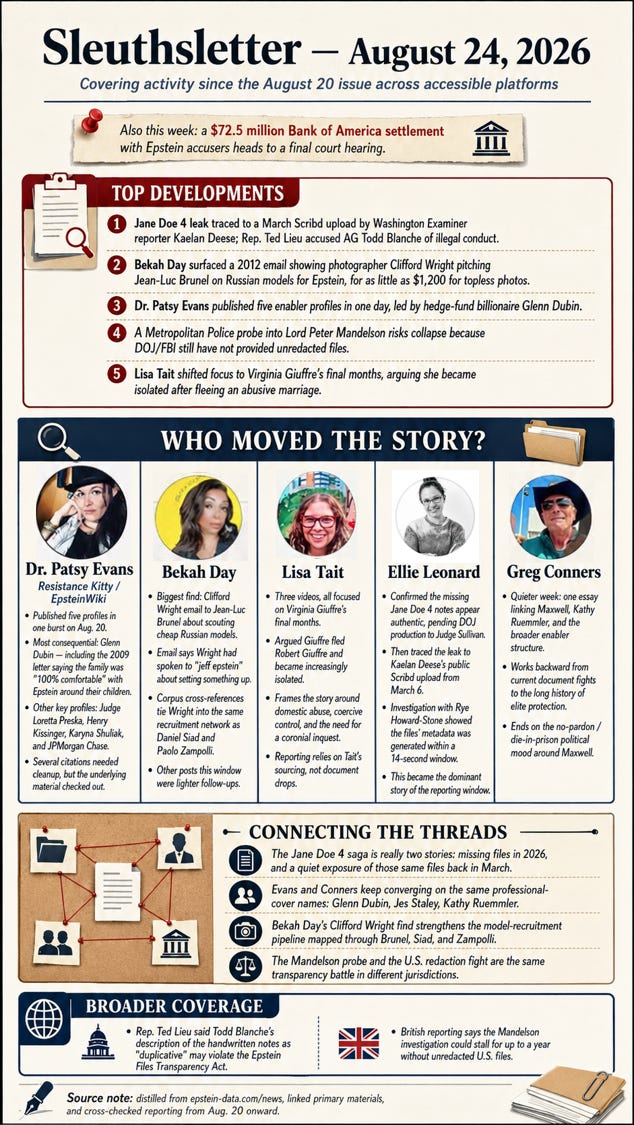
The leaked Jane Doe 4 notes Ellie Leonard reported last issue turned out to trace back to a five-month-old mistake by a Washington Examiner reporter. Working with data researcher Rye Howard-Stone, Leonard identified Kaelan Deese as the journalist who quietly uploaded the unredacted FBI handwritten notes — exposing the accuser’s real name — to a public Scribd account back in March, where they sat unnoticed until a Reddit user stumbled onto them this month. Rep. Ted Lieu has since accused Attorney General Todd Blanche of illegal conduct over the episode.
Bekah Day named an alleged new figure in Epstein’s modeling-recruitment pipeline. A 2012 email she surfaced and epstein-data.com independently verified shows photographer Clifford Wright pitching Jean-Luc Brunel on scouted Russian models for Epstein at rates as low as $1,200 “for topless photos.”
Dr. Patsy Evans’s EpsteinWiki published five enabler profiles in a single day, the most significant naming hedge-fund billionaire Glenn Dubin — whose household wrote a 2009 letter declaring itself “100% comfortable with Jeffrey Epstein around my children” — in connection with a Virginia Giuffre allegation that Epstein directed her to Dubin as a minor, which Dubin denies.
A Metropolitan Police investigation into Lord Peter Mandelson is at risk of collapse because the U.S. Department of Justice and FBI still haven’t handed over unredacted Epstein files nearly six months after his arrest.
Lisa Tait shifted her reporting toward Virginia Giuffre’s final months, arguing across three videos that Giuffre had fled an abusive marriage and become isolated before her death — a marked departure from her usual financial-associate beat.
Dr. Patsy Evans (Resistance Kitty)
Her EpsteinWiki knowledge base republished five long profiles in one burst on August 20, all cross-posted the same day to Mastodon, Bluesky and Threads, then went quiet on Epstein material for the rest of the window. “Judge Loretta Preska and the Epstein Records Unsealing Litigation” traces the SDNY judge’s handling of Giuffre v. Maxwell unsealing fights since 2019, explicitly debunking the “client list” framing some outlets attached to her 2024 release order and finding no evidence of any personal tie between Preska and Epstein. “Henry Kissinger and Jeffrey Epstein” is carefully hedged: it documents Kissinger’s name on a 2013 dinner-party guest list alongside Leon Black, Ehud Barak and Larry Summers (EFTA00284908) and more than a dozen scheduled meetings between Epstein and Kissinger Associates vice-chairman Joshua Cooper Ramo, but states plainly there are no flight logs, island visits, or direct Kissinger-Epstein emails in the record.
The most consequential piece, “Glenn Dubin and Jeffrey Epstein”, documents the Highbridge Capital co-founder’s sustained relationship with Epstein — including a 2009 letter signed by Glenn and Eva Dubin stating “I am 100% comfortable with Jeffrey Epstein around my children” (EFTA01245786) — alongside Virginia Giuffre’s allegation that Epstein and Maxwell directed her to have sex with Dubin as a minor, which Dubin “categorically” denies through a spokesperson. Two of the FBI-record citations underpinning that specific allegation are misfiled: the actual documents live at epstein-data.com/EFTA01249101, page 5 and epstein-data.com/EFTA00269896, page 4, not the standalone numbers the article cites — the underlying material checks out once corrected. A companion profile of Karyna Shuliak, Epstein’s final girlfriend, details a restated trust naming her a $50 million direct beneficiary plus a $50 million annuity and a 32-carat-plus ring “in contemplation of marriage” two days before his death (EFTA00099303), and notes she received his final ~20-minute jail phone call. And “JPMorgan Chase and Jeffrey Epstein” compiles the bank’s 2023 litigation record — 134 linked accounts, more than $1.1 billion in flagged wires, a general counsel who said in 2011 Epstein “was not honorable” but kept him as a client two more years — though nine of the ten document numbers it cites as independent evidence are actually just Bates-stamped pages inside one 69-page shareholder complaint, addressable instead at epstein-data.com/EFTA02822837 by page number.
bekah day
Her most document-driven find in weeks. “New Male Perpetrator’s Name Uncovered in The Epstein Files” (Aug 24) surfaces a May 2012 email in which photographer Clifford Wright tells Jean-Luc Brunel he’d been scouting models in Russia since 1999, got prices down to “like $1200 a model for topless photos,” and had “spoke to jeff epstein last summer about setting up something” — adding “I have a ton of wow girls let’s make some $?” (EFTA02556318, verified against the corpus). Cross-referencing the corpus turns up four more Wright emails to Epstein directly between 2014 and 2017, plus a 2013 scouting chain that also names Daniel Siad, the recruiter Day covered extensively in July and who was later found dead — tying Wright into the same noahmodels.com network. A second video, “Who Sent This INSANE Email To Epstein?!” (Aug 22), teases an unidentified sender’s email without naming them or citing a document number. A short, “Paolo Zampolli Links Back to ANOTHER Epstein Recruiter” (Aug 22), recaps her earlier Brazil/Zampolli reporting rather than breaking new ground.
Lisa Tait
A departure from her usual associate-focused reporting: three YouTube videos this window all concern Virginia Giuffre’s final months rather than Epstein’s financial network. In “How Virginia Giuffre Became Isolated From the World Before Her Death” (Aug 23), Tait reports that Giuffre fled her husband Robert Giuffre during a family trip to Perth, Australia, and that he later obtained a protection order against her; she cites unnamed family members describing disruptions to Giuffre’s phone, internet and utilities after she retreated to a family property. “Virginia Giuffre Saved Herself From Epstein. Not Her Husband” (Aug 23) argues against a public narrative of Robert Giuffre as his wife’s rescuer, saying the record shows “domestic turmoil, coercive control and physical abuse” in the marriage. And in “Bree Jones & Virginia Giuffre: Two Deaths, One Haunting Question” (Aug 24), a personal essay, Tait draws a parallel to a decades-old Australian case she once covered — the death of a 16-year-old given a lethal methadone dose at a party — saying it has shaped her belief that Giuffre’s family deserves a coronial inquest. None of the three cite documents; all rest on Tait’s own sourcing and framing.
Ellie Leonard
The dominant story of the window, and a direct sequel to the leak she reported last issue. After what she described as “a roller-coaster of verification,” Leonard confirmed in “Leaked FBI Notes Update” (Aug 22) that all 37 pages of the missing Jane Doe 4 notes — not just the 22 she’d initially posted — appear legitimate, after a source who’d previously seen the real notes matched handwriting and details in an unredacted copy. She was careful to note that full certainty won’t come until the DOJ produces the notes to Judge Emmet Sullivan. The bigger story landed two days later: in “The FBI Files Leaker is Named” (Aug 23), a livestream with Rye Howard-Stone, Leonard laid out how the notes were traced to Washington Examiner justice reporter Kaelan Deese, who had uploaded them unredacted to a public Scribd account back on March 6 — one day before publishing his own article about the files being missing, without ever disclosing he had them. Howard-Stone’s underlying investigation, “The Receipts” (Aug 23), found that the leaked files’ metadata was all generated within a 14-second window that day, that Deese’s other Scribd uploads normally get archived within a day but these sat un-archived for months, and that a Washington Examiner editor pulled the files within 78 minutes of being contacted, calling the posting “inadvertent.” Attorney Katie Phang, who is suing the DOJ over redactions, called the timing “interesting” given the files surfaced right after a status hearing in her case. Leonard’s two other livestreams this window — a Cohen/Trump conversation with Wajahat Ali and a Lev Parnas reaction segment, both over 45 minutes — covered general Epstein-adjacent politics rather than new documentary material.
Greg Conners
A quieter week after his busiest yet. His single post, “Epstein’s Contribution to American Reform” (Aug 21), works backward from the present — Ghislaine Maxwell held at FCI Bryan and a fresh order to unseal more documents over her objection — through Kathy Ruemmler’s July House testimony, in which she said Giuffre’s allegations “lacked inherent credibility” (a line Conners says “detonated” backlash after her February resignation from Goldman Sachs over emails calling Epstein “Uncle Jeffrey”), back to Maxwell’s 1991 arrival in New York after her father’s death and the recruitment “architecture” she built with Epstein and Jean-Luc Brunel. He closes on former Attorney General Pam Bondi’s quote hoping Maxwell will “hopefully die in prison” and a Senate resolution opposing any pardon.
Connecting the threads
The Jane Doe 4 story is really two stories about the same institutional failure, six years apart. Dr. Katie Chenoweth had no new output this window, but her February reporting with Roger Sollenberger and Nina Burleigh — which first established that three of the woman’s four FBI interviews had gone missing from the DOJ’s release — is the reason anyone was looking for these notes at all. Ellie Leonard’s and Rye Howard-Stone’s work this week closes the loop: the “missing” notes weren’t missing so much as quietly exposed by the government’s own selective leaking to a friendly reporter, then ignored for five months. Rep. Ted Lieu’s accusation against Attorney General Blanche (see below) is the direct downstream consequence of that reporting chain.
Enabler-network profiles are converging on the same handful of names. Patsy Evans’s Glenn Dubin and JPMorgan Chase pieces both surface Jes Staley as a connective figure — Dubin’s investment ties ran through Staley’s orbit at JPMorgan, and Staley was separately banned by UK regulators from senior financial-services roles over his own undisclosed Epstein relationship. Greg Conners’s essay lands on Kathy Ruemmler as a parallel case: a lawyer who moved from prosecuting white-collar crime to defending Epstein’s reputation, mirroring the “professional cover” theme Evans profiled the week before with Kosslyn, Alexander and Thacker.
Bekah Day’s Clifford Wright find plugs into a recruitment network several sleuths have now independently mapped. Wright’s 2012 pitch to Jean-Luc Brunel about scouting cheap Russian models sits in the same corpus neighborhood as Day’s July reporting on recruiter Daniel Siad and her ongoing Paolo Zampolli/Brazil thread — three separate names funneling into the same Brunel-run pipeline, discovered independently but describing one operation.
The UK’s Mandelson probe and the DOJ’s document fights are the same transparency fight wearing different clothes. Just as Scotland Yard can’t get unredacted files to build a case against Mandelson, Judge Sullivan’s court in Washington is still waiting on the DOJ to justify its redactions months after ordering it to. Both stall for the same practical reason: nobody outside the DOJ currently has real leverage to compel it.
Broader Epstein & transparency coverage
Rep. Ted Lieu accused Attorney General Todd Blanche of illegal conduct over the DOJ’s handling of the Jane Doe 4 notes, saying Blanche violated the Epstein Files Transparency Act by describing the withheld handwritten notes as “duplicative” of released material — a characterization the newly surfaced notes appear to contradict (Raw Story, Aug 23).
A Metropolitan Police investigation into Lord Peter Mandelson is at risk of collapse, according to reporting in The Times and The Telegraph, because neither the DOJ nor the FBI has granted a formal mutual-legal-assistance request for unredacted Epstein files nearly six months after Mandelson’s February arrest on suspicion of misconduct in public office; the process could take up to a year with no guarantee of release (Western Morning News, Aug 22).
Source note: this section draws on epstein-data.com/news’s clustered feed (via its API) plus independent web searches and verification, filtered to August 20 onward; every claim was checked against its underlying source and independently dated before inclusion.
Conchita Sarnoff is extremely knowledgeable on Epstein and his corrupt entourage. She already gave most of the answers to almost all possible Epstein’s questions regarding him trafficking girls, diplomats, cartels and Trump. YouTube, interviews, books, articles. All is answered there. She won’t elaborate further on Mexican cartels because it is way too dangerous.
The biggest question in all this is how does anyone file obstruction of justice charges against the Department of Justice?